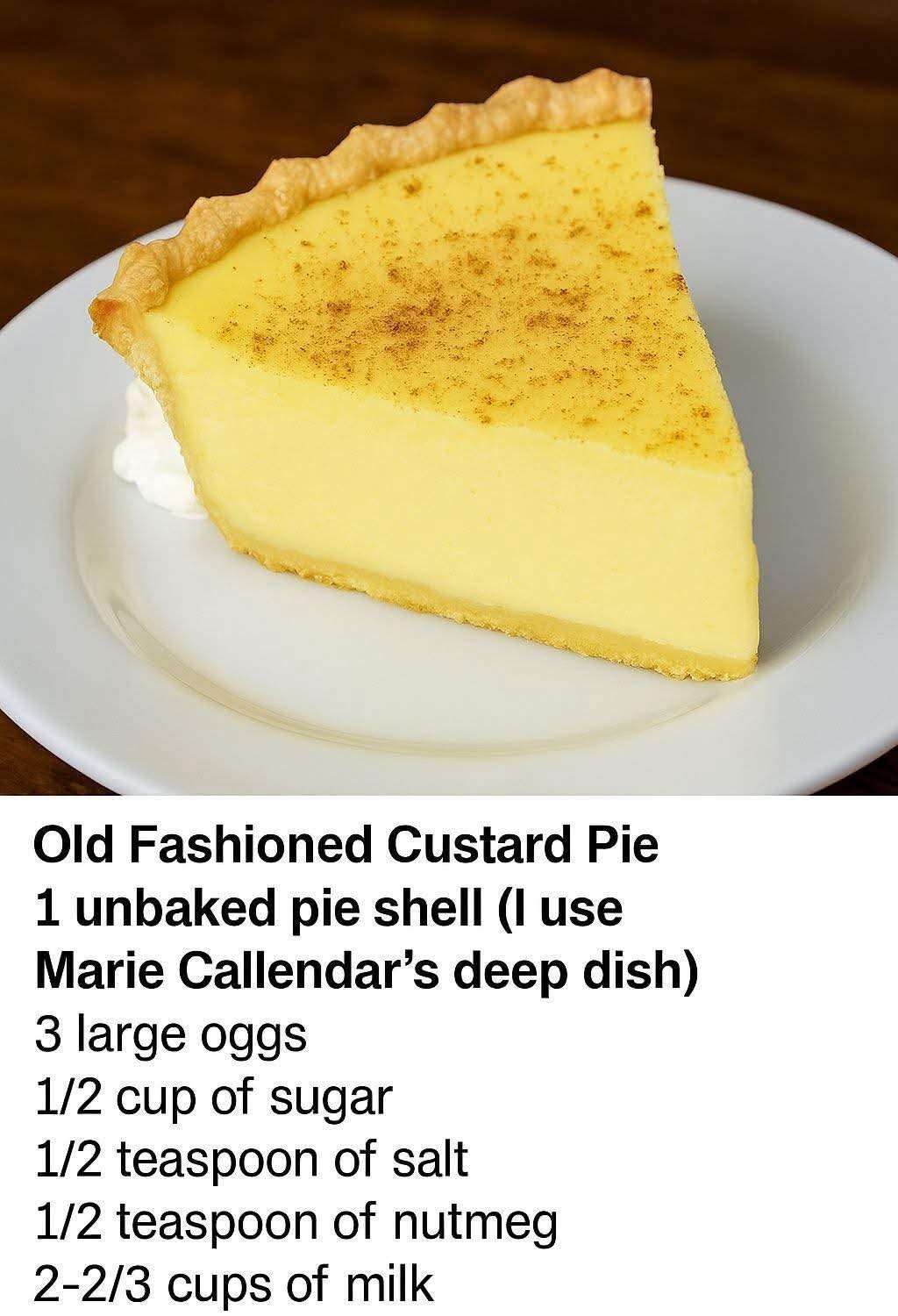
🥧 Old Fashioned Custard Pie (Classic Homemade Comfort)
There’s something quietly powerful about a custard pie. No fancy layers, no dramatic toppings—just simple ingredients that transform in the oven into something silky, tender, and deeply nostalgic. This is the kind of dessert that feels like it belongs in an old farmhouse kitchen, where recipes were passed down on handwritten cards and “a pinch of this” meant everything.
The Old Fashioned Custard Pie is one of those timeless desserts that never really leaves—it just waits for people to rediscover it.
🥚 Ingredients
- 1 unbaked pie shell (deep dish preferred, like Marie Callender’s style)
- 3 large eggs
- ½ cup granulated sugar
- ½ teaspoon salt
- ½ teaspoon ground nutmeg (plus extra for topping)
- 2⅔ cups whole milk
- 1 teaspoon pure vanilla extract
👩🍳 Method / Instructions
Preheat your oven to 350°F (175°C) and place your pie shell in a 9-inch deep dish pie pan.
In a mixing bowl, lightly beat the eggs—just enough to blend the yolks and whites smoothly without whipping too much air into them.
Add the sugar, salt, nutmeg, milk, and vanilla extract. Whisk until everything is fully combined and the mixture looks smooth and slightly frothy.
Carefully pour the custard mixture into the unbaked pie shell.
Place the pie on the middle rack of the oven and bake for 35 to 40 minutes, or until the center is just set. It should still have a gentle wobble—like soft-set jelly—because it will continue to firm up as it cools.
Remove from the oven and allow it to cool completely at room temperature.
Just before serving, sprinkle a light dusting of freshly grated nutmeg over the top for aroma and warmth.
🔬 Method Explained (Why It Works)
This pie relies on a gentle custard technique—eggs are the natural thickener. When heated slowly, the proteins in the eggs coagulate and trap the liquid milk into a soft, creamy structure.
The key is low and steady heat. Too hot, and the eggs scramble. Too fast, and the texture turns grainy instead of silky.
The milk brings creaminess, the sugar balances flavor, and the nutmeg adds warmth that defines classic custard pies.
📜 History & Tradition
Custard pies trace back centuries across Europe, especially in British and colonial American cooking. Early settlers used eggs, milk, and sugar—ingredients that were easy to access from farms.
Over time, the custard pie became a staple of Southern and rural American kitchens, often baked for Sunday dinners, holidays, or when guests were expected. It was considered a “humble luxury”—simple ingredients, but elegant results.
Nutmeg, once a prized spice in early trade routes, became the signature flavor that gave custard pies their unmistakable old-fashioned aroma.
🧁 Formation & Texture
When baked correctly, this pie forms three delicate layers:
- A lightly golden top, sometimes with tiny freckles of nutmeg
- A soft, creamy custard center that trembles slightly when cut
- A tender crust that holds everything together without overpowering it
The texture should be smooth like a baked cream, not dense like cheesecake and not runny like pudding.
💛 Serving & “Lovers” Moments
Custard pie is often described as a “quiet dessert”—but it has its own kind of romance.
It’s the slice served warm after dinner, shared between people who don’t need conversation to enjoy something together. It’s the kind of dessert that pairs well with tea, coffee, or even just silence at the table.
Some enjoy it slightly warm, when the vanilla scent is strongest. Others prefer it chilled, where the custard becomes firmer and more refreshing.
It’s simple food, but it has a way of making people slow down.
🍽️ Final Conclusion
The Old Fashioned Custard Pie is proof that elegance doesn’t require complexity. With just eggs, milk, sugar, and spice, you get a dessert that has survived generations because it simply works.
It’s soft, comforting, and timeless—one of those recipes that never really goes out of style because it was never trying to be trendy in the first place.
If you want, I can also turn this into a , or a .