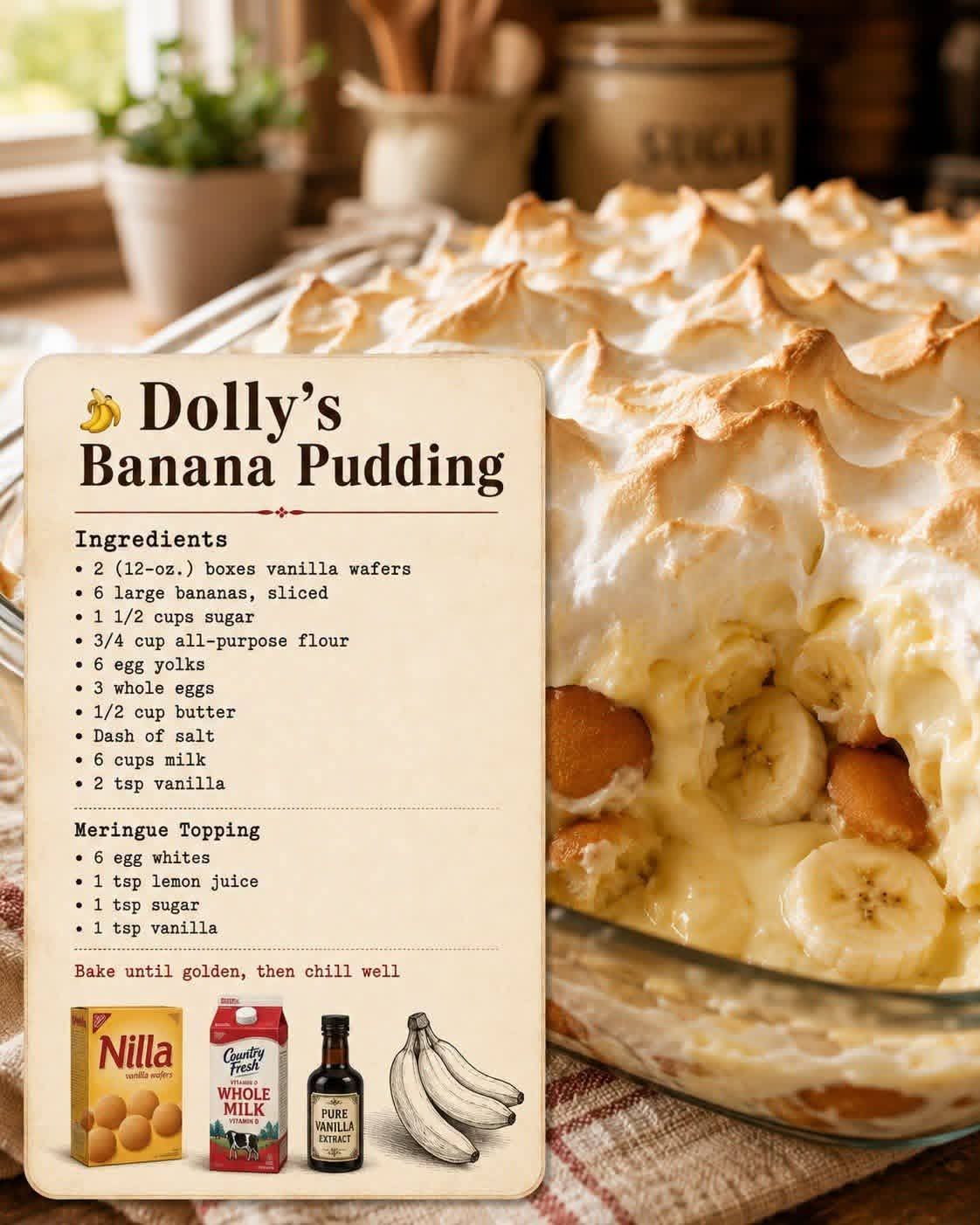
Dolly’s Banana Pudding
Introduction
Dolly’s Banana Pudding is a rich, old-fashioned Southern-style dessert built around simple ingredients and generous layers of creamy homemade vanilla pudding, ripe bananas, crisp vanilla wafers, and a soft golden meringue topping.
Unlike versions made entirely with instant pudding and whipped topping, this recipe creates its own homemade custard on the stovetop. Egg yolks and whole eggs give the pudding richness, flour helps it thicken, butter adds a silky finish, and vanilla provides the familiar flavor associated with classic banana pudding.
The vanilla wafers absorb some of the creamy custard as the dessert rests, becoming tender while still retaining enough texture to contrast with the bananas and pudding. The meringue is spread over the top and baked until beautifully golden, creating a lightly toasted finish.
This is the kind of dessert that feels nostalgic and comforting. It is ideal for Sunday dinners, family gatherings, holidays, potlucks, celebrations, and any occasion where a large homemade dessert is meant to be shared.
Ingredients
For the Banana Pudding
- 2 boxes vanilla wafers, 12 ounces each
- 6 large ripe bananas, sliced
- 1 1/2 cups granulated sugar
- 3/4 cup all-purpose flour
- 6 large egg yolks
- 3 large whole eggs
- 1/2 cup butter
- A dash of salt
- 6 cups milk
- 2 teaspoons vanilla extract
For the Meringue Topping
- 6 large egg whites
- 1 teaspoon lemon juice
- 1 teaspoon granulated sugar
- 1 teaspoon vanilla extract
Equipment
- Large saucepan
- Large mixing bowl
- Whisk
- Wooden spoon or heat-resistant spatula
- 9-by-13-inch baking dish
- Electric hand mixer or stand mixer
- Measuring cups and spoons
- Rubber spatula
Instructions
Step 1: Prepare the Baking Dish
Preheat the oven to approximately 350°F (175°C).
Lightly grease a large baking dish if desired. A 9-by-13-inch dish works well for this quantity, although a deep casserole dish can also be used.
Set the dish aside while preparing the layers.
Step 2: Prepare the Bananas
Peel the bananas and slice them into even rounds.
Choose bananas that are ripe and sweet but still firm enough to hold their shape. Extremely overripe bananas can become mushy when layered with the warm pudding.
Set the sliced bananas aside.
Step 3: Begin the Vanilla Pudding
In a large saucepan, combine the granulated sugar, flour, egg yolks, whole eggs, salt, and milk.
Whisk everything together thoroughly before placing the saucepan over the heat.
It is important to eliminate as many flour lumps as possible at this stage.
Step 4: Cook the Custard
Place the saucepan over medium heat.
Cook the mixture while stirring constantly with a whisk or heat-resistant spatula.
As the mixture heats, the eggs and flour will gradually thicken the milk.
Continue stirring, paying particular attention to the bottom and corners of the saucepan so the custard does not stick or scorch.
The pudding should eventually become thick, smooth, and creamy.
This process may take several minutes. Do not rush it by turning the heat excessively high.
Step 5: Finish the Pudding
Once the pudding has thickened, remove the saucepan from the heat.
Immediately stir in the butter and vanilla extract.
Continue stirring until the butter has completely melted and the vanilla is evenly distributed throughout the custard.
The finished pudding should be glossy, rich, and smooth.
Step 6: Create the First Layer
Arrange a layer of vanilla wafers across the bottom of the baking dish.
Place sliced bananas over the wafers.
Try to distribute the bananas evenly so every serving contains a good amount of fruit.
Step 7: Add the Pudding
Pour a generous portion of the warm vanilla pudding over the bananas and wafers.
Use a spatula to spread the pudding evenly.
The warm custard will begin soaking into the wafers, helping create the characteristic soft texture of traditional banana pudding.
Step 8: Repeat the Layers
Continue layering vanilla wafers, bananas, and pudding until the ingredients are used.
Depending on the depth of your dish, you may create two or three layers.
Finish with a layer of pudding so the top is smooth and ready for the meringue.
Method for the Meringue
Step 1: Prepare the Egg Whites
Place the six egg whites in a clean, completely dry mixing bowl.
Make sure there is no yolk mixed into the whites because even a small amount of fat can make it difficult to whip the egg whites properly.
Add the lemon juice.
Step 2: Beat the Egg Whites
Using an electric mixer, beat the egg whites and lemon juice until they become foamy.
Continue beating until the whites begin to hold their shape.
Step 3: Add Sugar and Vanilla
Add the sugar gradually while continuing to beat.
Add the vanilla extract.
Continue beating until the mixture becomes thick, glossy, and forms firm peaks.
When the beaters are lifted, the meringue should hold its shape rather than immediately falling back into the bowl.
Step 4: Spread the Meringue
Immediately spread the meringue over the warm pudding.
Use a spatula to push the meringue all the way to the edges of the baking dish.
Creating a complete seal around the edges helps protect the pudding underneath and gives the finished dessert its traditional appearance.
You can leave the surface smooth or create decorative peaks with the back of a spoon.
Step 5: Bake the Banana Pudding
Place the baking dish in the preheated oven.
Bake until the meringue becomes lightly golden brown.
This usually takes approximately 10 to 15 minutes, but the exact time can vary depending on the oven.
Watch the dessert carefully during the final minutes because meringue can go from golden to overly browned quickly.
Once beautifully golden, remove the pudding from the oven.
Step 6: Cool and Chill
Allow the banana pudding to cool at room temperature for a short period.
Then refrigerate it until thoroughly chilled.
For the best texture, allow the dessert several hours to rest before serving.
During this time, the vanilla wafers absorb some of the custard and become tender, the bananas blend into the pudding, and the flavors develop throughout the dish.
The History of Banana Pudding
Banana pudding is closely associated with Southern American cooking and has become one of the region’s most recognizable comfort-food desserts.
Its history developed alongside the increasing availability of bananas, commercially produced vanilla wafers, and custard-style desserts in the United States.
Bananas became more widely available in American markets during the late nineteenth and early twentieth centuries. At the same time, packaged vanilla wafers became a convenient ingredient for home cooks.
The combination was particularly successful because the wafers provided structure while the bananas contributed sweetness and fruitiness. A homemade vanilla custard brought everything together.
Over time, banana pudding became a favorite at family dinners, church gatherings, picnics, reunions, holidays, and Southern celebrations.
Many families developed their own versions. Some use homemade custard, while others use instant pudding. Some finish their desserts with whipped cream, while traditional Southern versions often feature baked meringue.
Dolly’s version follows the classic homemade-custard and meringue tradition.
Formation of the Dessert
The beauty of banana pudding comes from the way its individual components change as they come together.
The vanilla wafers begin with a crisp texture. Once surrounded by warm custard, they gradually soften and absorb the vanilla pudding.
The bananas remain tender and naturally sweet, creating a fruity contrast against the rich custard.
The homemade pudding forms the creamy foundation of the dessert. The combination of egg yolks, whole eggs, flour, milk, and butter gives it a thicker and richer texture than a simple milk-based pudding.
Finally, the meringue provides a light topping. When baked, the surface becomes golden and slightly toasted while remaining soft and airy underneath.
The result is a dessert containing several contrasting textures: crispness, tenderness, creaminess, and airy meringue.
Important Cooking Methods
Stir the Custard Constantly
The pudding should be stirred continuously while cooking.
This prevents the flour and eggs from settling on the bottom and reduces the chance of scorching.
Control the Heat
Medium heat is ideal.
Cooking the custard too aggressively can cause the eggs to scramble or create lumps.
Slow, steady heating gives you a smoother pudding.
Whisk Before Heating
Combining the ingredients while the milk is still cold makes it easier to distribute the flour and eggs evenly.
Use Fresh Eggs for the Meringue
Fresh egg whites generally whip beautifully and create a stable, glossy meringue.
Seal the Meringue
Spread the meringue completely to the edges of the baking dish.
This helps prevent the meringue from shrinking excessively while baking.
Do Not Overbake
The purpose of baking the meringue is primarily to create a beautiful golden surface.
Once the top has browned, the pudding does not need prolonged baking.
Tips for the Best Dolly’s Banana Pudding
Choose the Right Bananas
Use bananas that are yellow with a few brown spots but are still firm.
They should be sweet and flavorful without being overly soft.
Slice the Bananas Evenly
Uniform slices distribute the banana flavor throughout the dessert and make the finished layers more attractive.
Make the Custard Smooth
If your pudding develops small lumps, you can carefully pass it through a fine-mesh strainer before assembling the dessert.
Allow the Dessert to Rest
Banana pudding improves as it sits.
The vanilla wafers need time to absorb the custard and develop their signature tender texture.
Serve It Well Chilled
Although the pudding is assembled while the custard is warm, the finished dessert is best served chilled.
Make-Ahead Method
Dolly’s Banana Pudding is an excellent make-ahead dessert.
The entire dessert can be prepared several hours before serving and refrigerated.
Making it ahead allows the wafers to soften and the flavors to blend.
For the best appearance, keep the dessert covered while refrigerated, but avoid pressing plastic wrap directly against the meringue because it can stick to the surface.
Serving Suggestions
Serve the banana pudding cold in generous spoonfuls.
For a traditional presentation, simply serve it directly from the baking dish.
For individual servings, spoon the pudding into dessert bowls or glasses, making sure each serving contains:
- Vanilla wafers
- Banana slices
- Homemade vanilla custard
- Golden meringue
You can also garnish each serving with a whole or half vanilla wafer just before serving.
Variations
Extra-Banana Version
For an even stronger banana flavor, add another banana between the layers.
Whipped Cream Version
If you prefer a lighter topping, replace the meringue with sweetened whipped cream after the pudding has cooled completely.
Chocolate Banana Pudding
Add a thin layer of chocolate pudding between some of the vanilla pudding layers for a chocolate-banana variation.
Caramel Banana Pudding
Drizzle a small amount of caramel sauce between the banana and pudding layers.
Coconut Banana Pudding
Add a layer of lightly toasted shredded coconut for a tropical variation.
Common Problems and Solutions
The Custard Is Too Thin
The pudding may not have been cooked long enough. Continue cooking over medium heat while stirring until it reaches a clearly thick consistency.
The Custard Has Lumps
The eggs may have cooked too quickly or the flour may not have been fully incorporated.
Whisking continuously and cooking over moderate heat helps prevent this. A fine-mesh strainer can also smooth the finished custard.
The Meringue Weeps
Meringue can release moisture if it is unstable or if the dessert is stored for too long.
Make sure your mixing bowl is completely clean and that the egg whites are beaten properly.
The Bananas Turn Brown
Bananas naturally oxidize after being sliced. Using fresh bananas and assembling the dessert close enough to serving time helps minimize discoloration.
The Wafers Are Too Soft
Some softening is expected and is part of the character of banana pudding.
If you prefer more texture, reserve a few vanilla wafers and add them immediately before serving.
Conclusion
Dolly’s Banana Pudding is a comforting, generous dessert that celebrates the simplicity of classic Southern cooking.
The homemade vanilla custard provides the rich foundation, ripe bananas bring natural sweetness, vanilla wafers add their familiar flavor and texture, and the golden meringue completes the dessert with a beautiful finish.
The most important part of the recipe is not rushing the process. Give the custard enough time to thicken, allow the meringue to become glossy and stable, bake until the topping is golden, and refrigerate the finished pudding long enough for the layers to come together.
The final result is creamy, tender, rich, and nostalgic—the kind of dessert that can turn an ordinary family meal into something memorable.
For Lovers of Old-Fashioned Desserts
For lovers of homemade Southern desserts, Dolly’s Banana Pudding is especially satisfying because it brings together familiar ingredients in a traditional way.
There is something wonderful about a dessert made from scratch: the smell of warm vanilla custard, the sweetness of ripe bananas, the softness of wafers after they have absorbed the pudding, and the golden peaks of freshly baked meringue.
It is a recipe made for sharing. Bring it to a family gathering, place it on the table after Sunday dinner, or prepare it for a holiday celebration, and it is likely to disappear one serving at a time.
Final Method at a Glance
- Preheat the oven to 350°F (175°C).
- Slice the bananas.
- Layer vanilla wafers and bananas in a baking dish.
- Whisk sugar, flour, egg yolks, whole eggs, salt, and milk together.
- Cook over medium heat while stirring constantly.
- Continue until the pudding is thick and creamy.
- Remove from the heat and add butter and vanilla.
- Pour the warm pudding over the wafer and banana layers.
- Repeat the layers as needed.
- Beat egg whites with lemon juice until foamy.
- Add sugar and vanilla and beat until firm peaks form.
- Spread the meringue over the pudding.
- Bake until the meringue is golden.
- Cool briefly.
- Refrigerate thoroughly.
- Serve chilled and enjoy the classic homemade flavor.