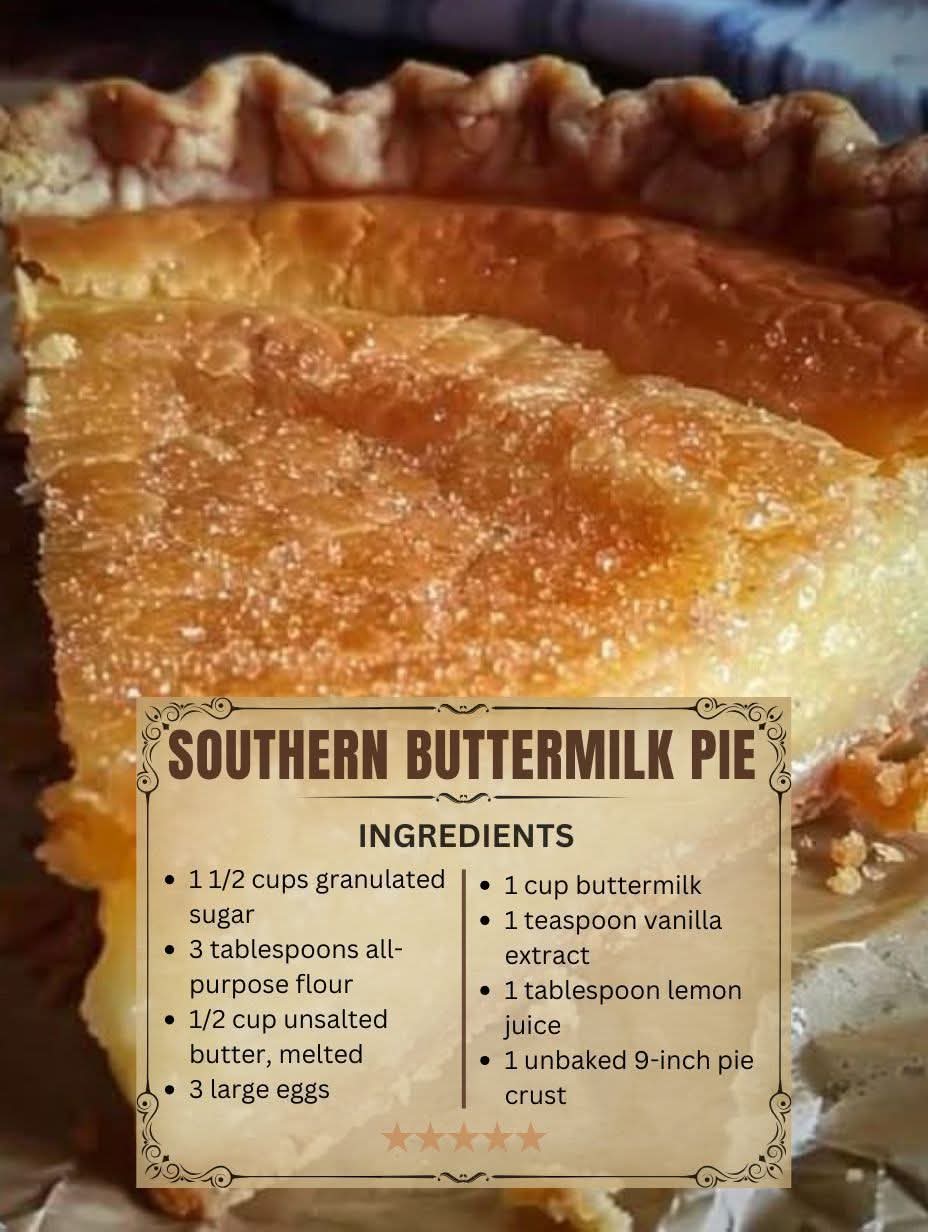
Southern Buttermilk Pie
Introduction
Southern Buttermilk Pie is a classic old-fashioned dessert known for its simple ingredients, creamy custard filling, and delicate sweetness. It is one of those pies that proves you do not need complicated ingredients to create something truly special. A buttery crust holds a smooth, rich filling made with buttermilk, eggs, sugar, butter, flour, and vanilla.
When baked, the filling transforms into a beautifully set custard with a lightly golden top. The flavor is sweet, creamy, buttery, and pleasantly tangy from the buttermilk. It is wonderful served slightly warm, at room temperature, or chilled, and it makes a comforting dessert for family dinners, holidays, potlucks, and gatherings.
Ingredients
For the Pie Filling
- 1 1/2 cups granulated sugar
- 3 tablespoons all-purpose flour
- 1/2 cup unsalted butter, melted and slightly cooled
- 3 large eggs
- 1 cup buttermilk
- 1 teaspoon vanilla extract
- 1 unbaked 9-inch pie crust
- 1/4 teaspoon salt
- 1 tablespoon fresh lemon juice, optional, for a slightly brighter flavor
- 1/2 teaspoon grated lemon zest, optional
For Serving
- Whipped cream, optional
- Fresh berries, optional
- A light dusting of powdered sugar, optional
Instructions
Step 1: Prepare the Oven
Preheat the oven to 350°F (175°C). Place an oven rack in the center of the oven.
If your pie crust has been refrigerated, allow it to sit for a few minutes so it is easier to work with. Place the crust into a 9-inch pie dish and gently press it into the bottom and sides.
Trim any excess dough around the edges and crimp the edges if desired.
Step 2: Combine the Dry Ingredients
In a medium mixing bowl, whisk together the granulated sugar, flour, and salt.
Mixing the flour with the sugar before adding the wet ingredients helps distribute the flour evenly throughout the filling and reduces the chance of lumps.
Step 3: Add the Butter
Slowly pour the melted butter into the sugar mixture.
Whisk until the butter is thoroughly incorporated. Make sure the butter has cooled slightly before adding the eggs so that it does not accidentally cook them.
Step 4: Add the Eggs
Add the three eggs one at a time, whisking gently after each addition.
Do not overbeat the mixture. You want the eggs incorporated without creating excessive air bubbles.
Step 5: Add the Buttermilk and Vanilla
Pour in the buttermilk and add the vanilla extract.
If using lemon juice and lemon zest, add them at this stage as well.
Whisk gently until everything is smooth and evenly combined.
Step 6: Fill the Pie Crust
Pour the prepared filling into the unbaked pie crust.
Place the pie carefully on a baking sheet. This makes it easier to move the pie in and out of the oven and also catches any small spills.
Step 7: Bake
Bake at 350°F (175°C) for approximately 45 to 55 minutes.
The outside should be set while the center should have a gentle jiggle when the pie is carefully moved. The surface should be lightly golden.
Avoid waiting until the center is completely firm in the oven because the custard will continue to set as it cools.
If the crust begins browning too quickly, loosely cover the edges with aluminum foil.
Step 8: Cool Completely
Remove the pie from the oven and place it on a cooling rack.
Allow it to cool for at least 1 to 2 hours before slicing. Cooling gives the custard time to finish setting and makes it much easier to achieve clean slices.
For an especially firm, chilled texture, refrigerate the pie after it has cooled to room temperature.
Method
The beauty of Southern Buttermilk Pie comes from the custard method. The sugar and flour are first combined to create an even base. Melted butter provides richness, while eggs give the filling structure. Buttermilk contributes its characteristic tang and helps create the smooth, creamy texture.
The mixture is poured directly into the pie crust and baked gently. As the pie heats, the eggs coagulate and the flour helps stabilize the custard. The result is a soft but sliceable filling surrounded by a crisp, buttery crust.
The key is to bake the pie until the edges are set while the center still has a slight movement. Overbaking can cause the custard to become firm, dry, or slightly grainy.
History of Southern Buttermilk Pie
Buttermilk Pie is closely associated with Southern American home cooking and has long been appreciated for its inexpensive, accessible ingredients. Buttermilk was traditionally a practical ingredient in many rural kitchens, particularly where butter was made at home.
Rather than wasting the leftover buttermilk, cooks found numerous ways to use it in biscuits, cakes, cornbread, pancakes, and pies. Buttermilk Pie became one of the most beloved desserts created from this humble ingredient.
The recipe also reflects an important tradition in Southern cooking: creating comforting food from ingredients that were already available in the pantry. Sugar, eggs, flour, butter, and buttermilk could be transformed into an elegant dessert without requiring expensive fruits, chocolate, or elaborate decorations.
Over generations, families developed their own versions. Some add lemon juice or zest, while others rely entirely on vanilla. Some recipes include nutmeg, cinnamon, or other warm spices. Despite these variations, the essential character remains the same: a rich, sweet, tangy custard baked inside a flaky crust.
Formation of the Pie
The formation of Southern Buttermilk Pie happens in several important stages.
First, the flour and sugar are evenly distributed. The melted butter then coats the mixture and adds richness. Eggs are incorporated to provide structure. Buttermilk brings moisture and acidity, while vanilla enhances the overall flavor.
During baking, the liquid filling gradually changes into a tender custard. The edges set first because they receive more heat from the sides of the pie dish. The center remains softer for longer and eventually sets as the pie cools.
This is why cooling is such an important part of the recipe. The pie may appear slightly soft when it first comes from the oven, but it continues to firm as its temperature decreases.
Important Baking Tips
Use room-temperature eggs and buttermilk when possible. They combine more easily and help create a smooth filling.
Do not use extremely hot melted butter. Allow it to cool slightly before mixing it with the eggs.
Whisk gently rather than vigorously. Too much air can create bubbles in the finished custard.
Do not overbake the pie. A slight jiggle in the center is desirable when the pie is removed from the oven.
Let the pie cool thoroughly before cutting. This is essential for clean slices.
For the best crust, use a good-quality pastry crust and avoid stretching it when placing it into the pie dish.
If you enjoy a more traditional spiced version, add approximately 1/4 teaspoon of freshly grated nutmeg to the filling.
Serving Suggestions
Southern Buttermilk Pie is delicious on its own because the filling is already rich and flavorful.
For a more indulgent presentation, serve each slice with a small spoonful of whipped cream.
Fresh strawberries, blueberries, raspberries, or blackberries also pair beautifully with the sweet and tangy custard.
The pie can be served slightly warm, at room temperature, or chilled. Each temperature gives the dessert a different character. Warm pie is soft and comforting, while chilled pie has a firmer, creamier texture.
Storage
Cover the cooled pie and refrigerate it because of the egg-based custard filling.
It is best enjoyed within several days. Keep it covered to prevent the crust from absorbing refrigerator odors and to preserve the quality of the filling.
For the best texture, allow refrigerated slices to sit at room temperature for a short time before serving if you prefer a softer custard.
Conclusion
Southern Buttermilk Pie is a wonderful example of traditional home baking. Its ingredients are simple, its preparation is straightforward, and the finished dessert is remarkably rich and satisfying.
The combination of buttery pastry, sweet custard, vanilla, and tangy buttermilk creates a pie that feels both humble and special. It is the kind of dessert that belongs on a family table, where recipes are passed from one generation to another and enjoyed long after the last slice has disappeared.
For lovers of old-fashioned desserts, this pie is especially appealing because it delivers homemade comfort without complicated techniques. It is simple enough for an ordinary family meal and special enough for holidays and celebrations.
For Lovers of Classic Southern Desserts
If you love traditional Southern baking, Southern Buttermilk Pie deserves a place in your recipe collection. It is economical, comforting, creamy, and wonderfully nostalgic.
Serve it to family, bring it to a gathering, or make it simply because you are craving a homemade dessert. Once properly cooled and sliced, each piece offers a smooth custard center surrounded by tender, buttery pastry.
This is a recipe worth keeping, sharing, and making again.