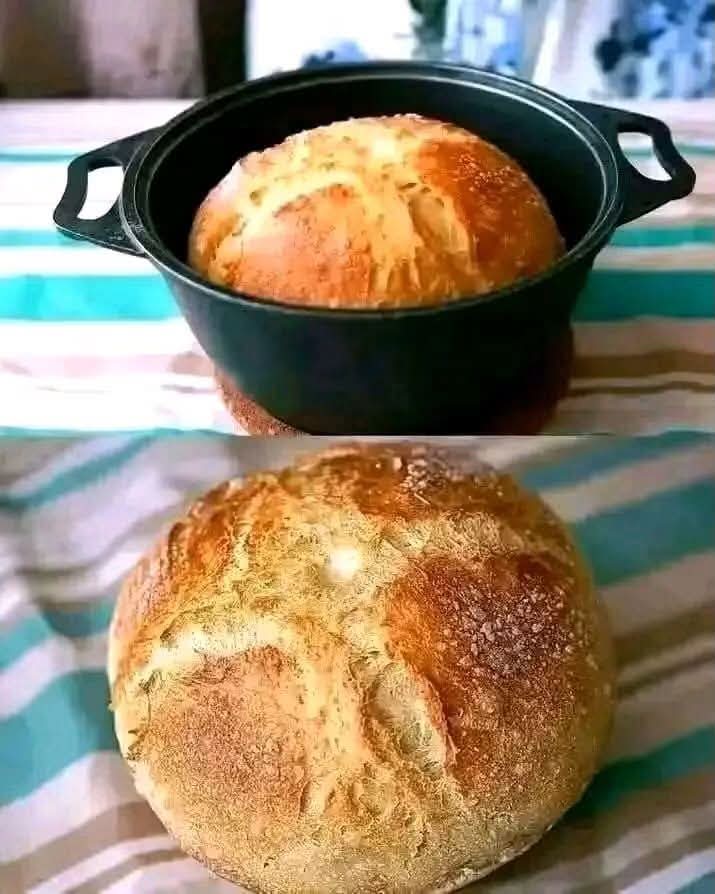
🥖 Homemade Everyday Bread — Soft, Golden & Absolutely Delicious
This is the kind of homemade bread that makes your kitchen smell incredible! 😍 With a crisp golden crust, a soft and fluffy center, and simple pantry ingredients, this recipe is easy enough for beginners and delicious enough to become your everyday favorite.
Once you try making this bread at home, you may never want to buy a loaf from the store again. ❤️
🥣 Ingredients
- 4 tablespoons (60 ml) olive oil
- 1 tablespoon (10 g) active dry yeast
- 1 teaspoon salt
- 1⅓ cups (320 ml) warm water
- 4¾ cups (570 g) plain/all-purpose flour
- 1 teaspoon sugar or honey (optional, but helps activate the yeast)
- Extra flour for shaping
- Extra olive oil for greasing
Optional toppings
- Sesame seeds
- Nigella seeds
- Poppy seeds
- Dried herbs
- Coarse salt
- A little olive oil
👩🍳 Instructions
1. Activate the yeast
Pour the warm water into a large mixing bowl. The water should feel pleasantly warm, not hot.
Add the yeast and optional sugar or honey. Stir gently and leave for about 5–10 minutes.
If the mixture becomes slightly foamy, your yeast is ready.
2. Make the dough
Add the olive oil and salt.
Gradually add the flour, mixing with a wooden spoon or your hands. Continue adding flour until a soft dough begins to form.
Don’t add all the flour at once. Depending on the flour and humidity, you may need slightly more or less.
3. Knead
Transfer the dough to a lightly floured work surface.
Knead for approximately 8–10 minutes, stretching and folding the dough until it becomes smooth and elastic.
The dough should feel soft and slightly tacky but shouldn’t stick heavily to your hands.
4. First rise
Place the dough into a lightly oiled bowl.
Turn the dough once so the surface is lightly coated with oil. Cover with a clean kitchen towel or plastic wrap.
Leave it somewhere warm for approximately 1–1½ hours, or until it has roughly doubled in size.
5. Shape the bread
Gently press the dough down to remove excess air.
Place it on your work surface and shape it into one large round loaf or divide it into 2 smaller loaves.
Place the shaped dough onto a lined baking tray.
Cover again and allow it to rest for 25–40 minutes.
6. Prepare for baking
Preheat your oven to 220°C (425°F).
Brush the surface lightly with olive oil.
Using a sharp knife, make a few shallow cuts across the top of the loaf. This allows the bread to expand beautifully during baking.
Sprinkle with sesame seeds, nigella seeds, or your favorite topping if desired.
7. Bake
Place the bread in the hot oven.
Bake for approximately 25–35 minutes, depending on the size of your loaf.
The bread should become beautifully golden brown and sound hollow when tapped underneath.
For an extra-crisp crust, place a small oven-safe dish of hot water in the oven during the first 10–15 minutes of baking.
8. Cool
Remove the bread from the oven and place it on a wire rack.
Allow it to cool for at least 30 minutes before slicing.
I know it’s tempting to cut into it immediately—but letting it cool allows the crumb to finish setting and gives you those beautiful, soft slices. 😍
🌾 The Method Behind Great Homemade Bread
The secret isn’t complicated ingredients—it’s time, temperature, hydration, and kneading.
The yeast produces carbon dioxide as the dough ferments. Those tiny bubbles become trapped within the developing gluten network, causing the dough to rise and giving the finished bread its characteristic airy texture.
Kneading develops the gluten, while the resting periods allow the dough to relax and ferment. Finally, the high oven temperature creates the beautiful golden crust we all love.
📜 A Little History of Homemade Bread
Bread is one of humanity’s oldest prepared foods. Ancient civilizations discovered that grinding grains into flour and combining them with water created a simple dough that could be cooked over heat.
The discovery and use of fermentation transformed bread-making. Wild yeasts naturally present in the environment could ferment dough, producing lighter and more flavorful loaves.
Over centuries, bread became a fundamental food in cultures around the world. Every region developed its own styles, shapes, grains, techniques, and traditions.
Modern commercial yeast makes the process much faster and more predictable, but the basic principle remains wonderfully simple: flour + water + fermentation + heat = bread. ❤️
✨ Formation & Texture
During baking, several amazing things happen:
The dough expands:
Heat causes gases inside the dough to expand, giving the loaf its final lift.
The crust develops:
The surface dries and browns, creating a flavorful golden crust.
The crumb sets:
The interior changes from soft dough into the fluffy bread we recognize.
The aroma develops:
Browning reactions create the rich, toasted aroma that makes freshly baked bread so irresistible.
🥪 Ways to Enjoy Your Homemade Bread
This bread is incredibly versatile!
❤️ Serve warm with butter.
🧀 Make a grilled cheese sandwich.
🥪 Use it for chicken, tuna, or vegetable sandwiches.
🍳 Serve alongside eggs for breakfast.
🍅 Toast slices and top with tomatoes, olive oil, and herbs.
🧄 Turn it into garlic bread.
🥣 Serve alongside soups and stews.
🫒 Dip pieces into olive oil and herbs.
🍯 Enjoy toasted slices with honey or jam.
💡 Helpful Baker’s Tips
Don’t use very hot water.
Extremely hot water can damage or kill the yeast.
Don’t overload the dough with flour.
A slightly soft dough generally produces a lighter loaf.
Give the dough enough time to rise.
The exact rising time depends on room temperature and yeast activity.
Don’t skip the second rise.
This helps create a lighter, more delicate texture.
Let the bread cool before cutting.
It may seem like a small detail, but it makes a noticeable difference.
For a softer crust:
Brush the freshly baked loaf lightly with olive oil or butter and cover it with a clean towel while cooling.
❤️ For the Bread Lovers
There is something special about homemade bread.
It’s not just the taste. It’s the sound of the crust cracking as you slice it, the warm aroma filling the kitchen, and that first soft bite while the bread is still slightly warm.
And the best part?
You made it yourself. 🥖❤️
🏡 Final Thoughts
This simple recipe proves that delicious homemade bread doesn’t require expensive equipment or complicated techniques.
With just flour, yeast, water, salt, and olive oil, you can create a beautiful loaf with a golden crust and soft, fluffy interior.
Once you master this basic recipe, you can experiment with whole-wheat flour, herbs, garlic, cheese, olives, seeds, or roasted vegetables to create your own signature loaf.
Fresh bread, straight from your own oven, is hard to beat. 😍🥖
If you love homemade bread, save this recipe and share it with someone who would love to bake it! ❤️
Must express something to keep getting my recipes… Thank you! 🥰