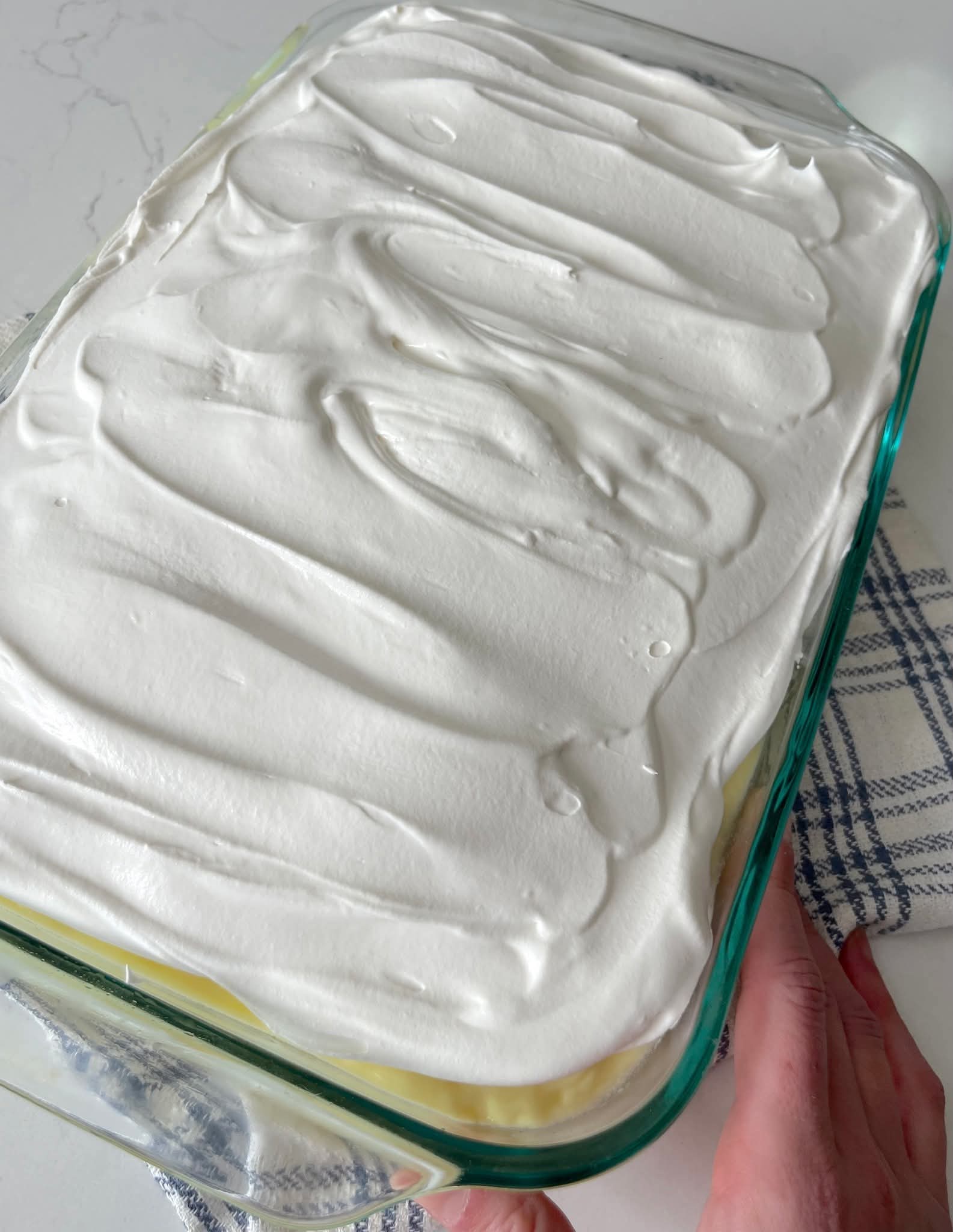
Church Cake is one of those old-fashioned, community-style desserts that lives more in memory than in cookbooks. It’s the kind of cake you’d find on a folding table at a church potluck, sitting next to banana pudding and sweet tea, quietly disappearing slice by slice before anyone even finishes their plate. Nobody ever really agrees on its exact origin because every community seems to have their own version—but that’s part of the charm. It’s less about precision and more about comfort, generosity, and that “just one more piece” feeling.
At its heart, Church Cake is usually a soft, buttery sheet cake topped with a warm, sweet sauce—often caramel, coconut-pecan, or vanilla cream—that soaks into the cake and makes it incredibly moist. It’s simple, nostalgic, and dangerously easy to love.
🍰 Church Cake (Classic Community Version)
🧾 Ingredients
For the cake:
- 2 cups all-purpose flour
- 1 ½ cups granulated sugar
- ½ cup unsalted butter, softened
- 2 large eggs
- 1 cup buttermilk (or milk + 1 tbsp vinegar)
- 1 tsp vanilla extract
- 1 tsp baking soda
- ½ tsp salt
For the topping (classic church-style sauce):
- 1 cup evaporated milk
- 1 cup granulated sugar
- ½ cup butter
- 1 tsp vanilla extract
- Optional: ½ cup shredded coconut or chopped pecans
👩🍳 Instructions
1. Prepare the cake base
Preheat your oven to 350°F (175°C).
Grease a 9×13-inch baking pan.
In a large bowl, cream together the butter and sugar until light and fluffy. Add eggs one at a time, mixing well after each. Stir in vanilla.
In another bowl, mix flour, baking soda, and salt.
Alternate adding dry ingredients and buttermilk into the butter mixture, starting and ending with dry ingredients. Mix until smooth—don’t overbeat.
Pour into the prepared pan and smooth the top.
Bake for 30–35 minutes, or until a toothpick comes out clean.
2. Make the church topping
While the cake is baking, combine evaporated milk, sugar, and butter in a saucepan over medium heat. Stir constantly until it begins to gently boil and thicken (about 5–7 minutes). Remove from heat and stir in vanilla.
If using coconut or pecans, mix them in now.
3. The “church magic” moment
As soon as the cake comes out of the oven, poke small holes all over the top using a fork or skewer. Slowly pour the warm topping over the hot cake so it soaks in.
Let it rest for at least 1 hour before serving—if you can wait that long.
🧠 Method & Formation (Why it works)
Church Cake works because of absorption. The warm sauce seeps into the sponge, transforming a simple cake into something richer and heavier in flavor without needing frosting. The holes create pathways for moisture, and the butter-sugar mixture locks in softness for days.
It’s basically science disguised as comfort food.
📜 A Little History
Church cakes became popular in Southern-style community cooking traditions in the U.S., especially in the mid-20th century. They were designed to feed large groups cheaply, travel well, and taste even better the next day. Every church, family reunion, or funeral gathering seemed to have its own “secret version,” often passed down without written recipes.
That’s why no two Church Cakes ever taste exactly the same.
💛 Why people love it
People don’t just like Church Cake—they remember it.
- It shows up at big gatherings
- It’s always gone too fast
- It tastes even better cold the next day
- It feels like home, even if you’ve never had it before
It’s the kind of dessert where people quietly hover near the pan, hoping someone says “go ahead, take another slice.”
🍽 Serving ideas
- Warm with a scoop of vanilla ice cream
- Chilled straight from the fridge
- With coffee for breakfast (no judgment in church cake world)
❤️ Conclusion
Church Cake isn’t fancy. It doesn’t try to impress anyone. But that’s exactly why it wins every time. It’s soft, sweet, nostalgic, and built for sharing—though nobody ever really wants to share once they’ve had a bite.
😄 Final “lovers of Church Cake” truth
If you know, you know: The first slice is a taste…
The second slice is a decision…
And the third slice means you’ve officially stopped pretending you were only having “a little.”
If you want, I can also make a , , or —those are even more addictive.