Creamy Staples Made Simple: A Homemade Dairy Guide (Butter, Cream, Cheese & More)
Introduction
There’s something deeply satisfying about making kitchen staples from scratch. Butter, mayonnaise, cream cheese, sour cream, and even heavy cream substitutes are often seen as “store-only” items, but they’re actually simple transformations of basic ingredients like milk, cream, eggs, and oil.
Homemade versions don’t just taste fresher—they also give you control over texture, salt, richness, and purity. These recipes are rooted in centuries-old food preservation methods, where households turned perishable milk into longer-lasting, more versatile forms.
This guide brings together five essential creamy staples you can easily prepare at home with minimal tools.
1. Homemade Butter
Ingredients
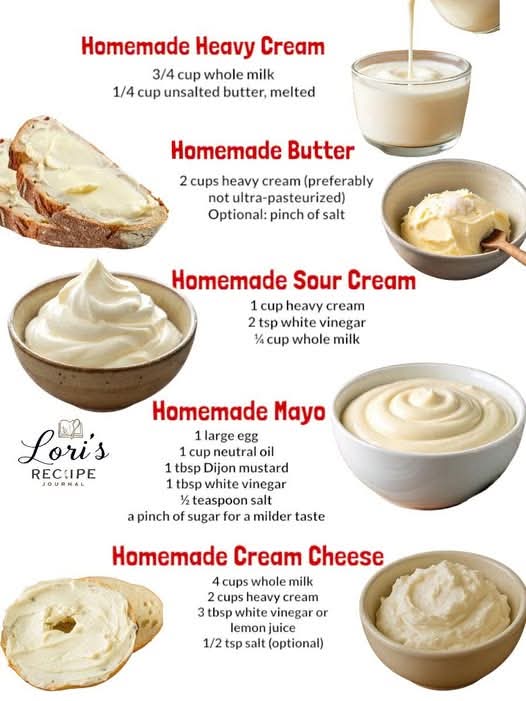
- 2 cups heavy cream (preferably not ultra-pasteurized)
- Optional: pinch of salt
Method & Instructions
Step 1: Whipping Phase
Pour heavy cream into a stand mixer, food processor, or sealed jar. Whip or shake until it transforms into whipped cream.
Step 2: Separation Phase
Continue mixing until it suddenly separates into:
- Solid butter
- Liquid buttermilk
Step 3: Drain
Strain off the buttermilk (save it for baking pancakes, bread, or cakes).
Step 4: Wash the Butter
Rinse under cold water while kneading gently. Repeat until the water runs clear—this removes leftover buttermilk and improves shelf life.
Step 5: Season & Store
Add salt if desired and mix well. Store in an airtight container in the fridge.
Formation Science
Butter forms when fat molecules in cream collide and clump together, separating from water and proteins. This mechanical separation is one of the oldest known food transformations in human history.
History
Butter dates back over 4,000 years, with origins in ancient Mesopotamia and pastoral cultures where milk was shaken in animal skins.
For Lovers Of…
Rich spreads, farmhouse cooking, and rustic homemade flavor.
2. Homemade Heavy Cream Substitute
Ingredients
- 3/4 cup whole milk
- 1/4 cup unsalted butter (melted and cooled slightly)
Instructions
- Melt butter and let it cool slightly.
- Pour milk into a bowl or blender.
- Slowly whisk in melted butter until fully emulsified.
Method Insight
This is a simple emulsion—fat dispersed into milk to mimic cream’s fat content.
Important Note
This substitute works for cooking and baking, but it does not whip like real heavy cream.
Formation Concept
You are artificially recreating the fat percentage of cream (~36%) by blending milk and butter fat.
For Lovers Of…
Quick baking fixes and emergency kitchen solutions.
3. Homemade Cream Cheese
Ingredients
- 4 cups whole milk
- 2 cups heavy cream (optional, for richness)
- 2–3 tbsp white vinegar or lemon juice
- 1/2 tsp salt (optional)
Instructions
Step 1: Heat
Warm milk (and cream) to 185–195°F (85–90°C), stirring gently.
Step 2: Acid Add
Add vinegar or lemon juice. Curds will form and separate from whey.
Step 3: Rest
Let sit for 10–15 minutes.
Step 4: Strain
Pour through cheesecloth and drain 15–30 minutes.
Step 5: Blend
Blend curds until smooth. Add salt to taste.
Method Explanation
This is acid coagulation—acids destabilize milk proteins (casein), causing curds to form.
History
Cream cheese originated in the United States in the late 1800s and became widely popular thanks to dairy innovation and refrigeration.
Formation Insight
You are separating milk solids from liquid whey, then emulsifying them back into a smooth spread.
For Lovers Of…
Bagels, cheesecake bases, and creamy spreads.
4. Homemade Mayonnaise
Ingredients
- 1 large egg (room temperature)
- 1 cup neutral oil (canola, sunflower, or light olive oil)
- 1 tbsp mustard
- 1 tbsp vinegar or lemon juice
- 1/2 tsp salt
- Optional: pinch of sugar
Instructions
Step 1: Base Mix
Combine egg, mustard, vinegar, and salt in a jar or bowl.
Step 2: Emulsify
Add oil and blend with an immersion blender (or whisk slowly while adding oil gradually).
Step 3: Thicken
It should turn creamy and thick within seconds.
Step 4: Adjust
Add seasoning to taste.
Method Explanation
Mayonnaise is a cold emulsion—oil droplets suspended in egg yolk proteins and stabilized by mustard and acid.
History
Mayonnaise is believed to have originated in 18th-century France or Spain, becoming a global staple in sauces and dressings.
Formation Concept
You are forcing oil and water-based ingredients to stay mixed using emulsifiers.
For Lovers Of…
Sandwiches, dips, fries, and creamy sauces.
5. Homemade Sour Cream
Ingredients
- 1 cup heavy cream
- 2 tsp white vinegar or lemon juice
- 1/4 cup whole milk
Instructions
Step 1: Mix Acid & Cream
Stir cream and vinegar together.
Step 2: Add Milk
Mix in milk evenly.
Step 3: Ferment Rest
Leave at room temperature 12–24 hours until thickened.
Step 4: Chill
Refrigerate before serving.
Method Explanation
This is mild fermentation/acidification—proteins thicken as acidity increases.
History
Sour cream has Eastern European origins, traditionally made by letting raw cream naturally ferment.
Formation Insight
It thickens as bacteria or acid changes protein structure and viscosity.
For Lovers Of…
Tacos, baked potatoes, and creamy dips.
Conclusion
These five staples show how simple ingredients—milk, cream, eggs, and oil—can transform into entirely different textures and flavors through chemistry, time, and technique.
What looks like “advanced cooking” is really just controlled separation, emulsification, and fermentation.
Once you understand these foundations, your kitchen becomes a small dairy workshop where nothing goes to waste and everything becomes versatile.
Final Thought (For True Homemade Food Lovers)
People who enjoy making these staples aren’t just cooking—they’re reconnecting with older food traditions where freshness, control, and simplicity mattered more than packaging. Every batch of butter or mayo is slightly different, and that’s part of the charm: real food, made by hand, shaped by you.