Cloud Cake: A Light, Creamy Blender Cake
Introduction
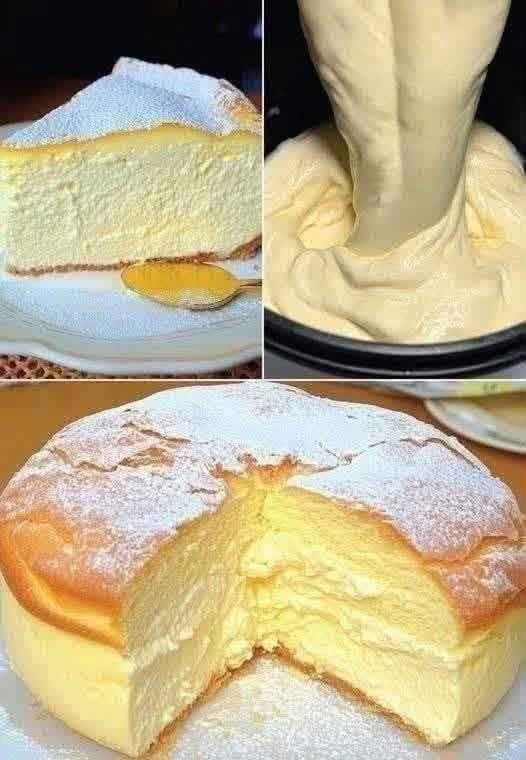
Cloud Cake is a wonderfully soft and delicate dessert with a creamy texture, a gentle vanilla flavor, and a melt-in-your-mouth finish. The name comes from its incredibly light texture: the cake is tender and airy rather than dense or heavy. Even better, much of the preparation can be done in a blender, making this an easy dessert for both beginners and experienced home bakers.
This recipe combines cream cheese, butter, milk, eggs, and a small amount of flour and cornstarch to create a cake that is rich enough to be satisfying while remaining wonderfully fluffy. It is the kind of dessert that is easy to make once and quickly becomes a regular favorite.
Ingredients
For the Cloud Cake
- 200 g (7 oz) cream cheese, softened
- 50 g (3½ tbsp) unsalted butter, softened
- 100 ml (about 7 tbsp) milk
- 4 large eggs, separated
- 70 g (⅓ cup) granulated sugar
- 40 g (⅓ cup) cake flour
- 10 g (1 tbsp) cornstarch
- 1 teaspoon vanilla extract
- A small pinch of salt, optional
For Preparing the Pan
- A little butter for greasing
- Parchment paper
- Hot water for the water bath, if using a springform or loose-bottomed pan
Instructions
1. Prepare the Oven and Pan
Preheat the oven to 160°C (320°F).
Grease a round cake pan and line the bottom with parchment paper. If your pan has a removable bottom, wrap the outside securely with aluminum foil to prevent water from entering during the water bath.
A water bath is highly recommended because it helps the cake bake gently and evenly while maintaining its soft, creamy texture.
2. Prepare the Cream Cheese Mixture
Place the softened cream cheese, butter, and milk into a blender.
Blend until completely smooth and creamy. There should be no visible lumps of cream cheese or butter.
Add the egg yolks and vanilla extract and blend briefly until everything is incorporated.
Do not overblend at this stage. The goal is simply to create a smooth mixture.
3. Prepare the Dry Ingredients
In a separate bowl, sift together the cake flour and cornstarch.
Sifting is important because it removes lumps and helps distribute the starch evenly throughout the batter.
Gradually add the dry ingredients to the cream cheese mixture. Blend very briefly or whisk gently until just combined.
Do not overmix.
4. Whip the Egg Whites
Place the four egg whites in a completely clean, dry mixing bowl.
Beat the egg whites until they become foamy. Gradually add the granulated sugar while continuing to beat.
Continue until you have a glossy meringue that reaches soft to medium peaks.
The egg whites are one of the most important parts of the recipe. They provide the air that gives Cloud Cake its characteristic light texture.
5. Fold Everything Together
Add approximately one-third of the whipped egg whites to the cream cheese batter.
Gently fold them in to loosen the mixture.
Add the remaining egg whites in two additions, folding gently after each addition.
Use a spatula and make slow movements from the bottom of the bowl upward. Avoid stirring aggressively because you do not want to knock the air out of the whipped egg whites.
The finished batter should be smooth, airy, and noticeably lighter than the original cream cheese mixture.
6. Fill the Pan
Pour the batter into the prepared cake pan.
Gently tap the pan once or twice on the counter to release any large air bubbles, but do not knock it forcefully.
Place the cake pan into a larger roasting pan and carefully pour hot water into the roasting pan until it reaches approximately 2–3 cm up the side of the cake pan.
7. Bake Slowly
Place the cake in the preheated oven and bake at 160°C (320°F) for approximately 45–55 minutes, depending on the size and depth of your pan.
The cake should rise beautifully and become lightly golden on top.
Once baked, turn off the oven and leave the cake inside with the door slightly open for approximately 10–15 minutes.
This gradual cooling helps reduce the chance of the cake collapsing suddenly.
8. Cool the Cake
Remove the cake from the oven and carefully take it out of the water bath.
Allow it to cool in the pan for a little while before removing it completely.
Cloud Cake can be served slightly warm, at room temperature, or chilled. Chilling gives it an especially creamy and cheesecake-like texture.
Method
The key method behind this cake is the combination of a smooth cream cheese batter and carefully whipped egg whites.
The cream cheese, butter, milk, and egg yolks create richness and moisture. The cake flour provides enough structure to hold the cake together, while cornstarch keeps the crumb delicate and tender.
The whipped egg whites are then folded into the batter. As the cake bakes, the trapped air expands, creating the light and airy structure that gives Cloud Cake its name.
Finally, gentle baking in a water bath provides moist, even heat and helps prevent the delicate cake from becoming dry.
History and Inspiration
Cloud-style cakes belong to a broader tradition of delicate cakes that emphasize softness, airiness, and a creamy texture rather than a dense crumb.
The technique of incorporating whipped egg whites into a rich dairy-based batter is closely related to the methods used in several Japanese-style cheesecakes and other light sponge desserts. These cakes became popular because they offer the richness of cheesecake while maintaining the airy texture of a sponge cake.
Modern blender recipes simplify the preparation even further. Instead of preparing the cream cheese mixture entirely by hand, a blender can quickly create a smooth base, making this type of cake much more approachable for everyday baking.
Formation of the Cake
The formation of Cloud Cake happens in several stages.
First, the cream cheese mixture forms the rich foundation of the cake. Then the whipped egg whites introduce thousands of tiny air bubbles into the batter.
During baking, these air bubbles expand. At the same time, the proteins in the eggs and the starches and proteins in the flour begin to set, creating a stable structure around the bubbles.
The result is a cake that rises gently and develops a soft, tender interior.
The cooling stage is equally important. Cooling the cake gradually allows its structure to settle without causing a dramatic temperature change that could make it shrink excessively.
Tips for the Best Cloud Cake
Use room-temperature cream cheese, butter, and eggs whenever possible. They combine more easily and create a smoother batter.
Do not overbeat the egg whites. Extremely stiff, dry egg whites can be more difficult to fold into the batter and may result in a less even texture.
Fold gently. This is perhaps the most important step for achieving the signature cloud-like crumb.
Do not open the oven repeatedly while the cake is baking. Sudden temperature changes can cause a delicate cake to sink.
Allow the cake to cool gradually after baking.
For an extra creamy texture, refrigerate the completely cooled cake for several hours before serving.
Serving Ideas
Cloud Cake is delicious on its own, but it can also be served with:
- Fresh strawberries
- Blueberries or raspberries
- A light dusting of powdered sugar
- Fresh whipped cream
- A spoonful of fruit compote
- Lemon or berry sauce
- Freshly sliced peaches
- A small drizzle of honey
For a simple presentation, place the cooled cake on a serving plate and dust the top lightly with powdered sugar.
Why Lovers of This Cake Keep Making It
There is something particularly satisfying about a dessert that looks elegant but does not require complicated decoration.
Cloud Cake has a creamy center, a delicate crumb, and a subtle vanilla flavor. It is rich without feeling excessively heavy, making it suitable for afternoon tea, family gatherings, celebrations, or simply a homemade treat during the week.
And because the preparation is so straightforward, it is easy to understand why someone might find themselves making it twice a week.
Conclusion
Cloud Cake is a beautiful example of how a handful of simple ingredients can create an extraordinary dessert. Cream cheese provides richness, butter adds tenderness, milk contributes moisture, and whipped egg whites create the characteristic lightness.
The most important secrets are gentle folding, careful baking, and gradual cooling. Once those techniques are mastered, this cake becomes a dependable recipe that can be made again and again.
If you love soft, creamy, delicate cakes, this is one recipe worth keeping close.
Must express something to keep getting my recipes.