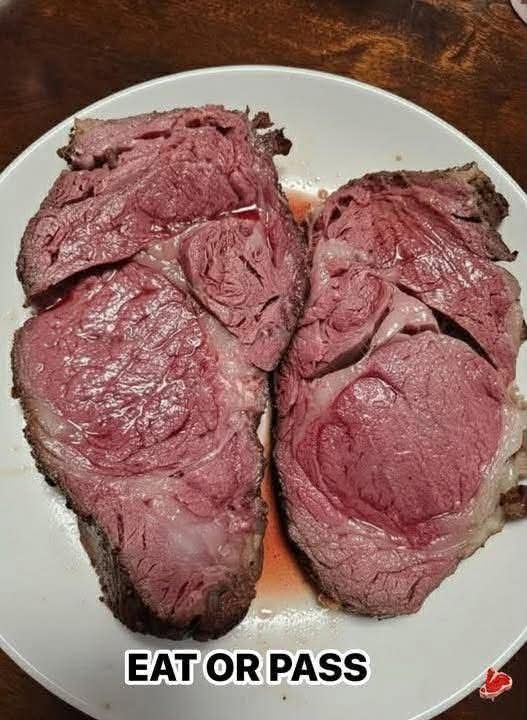
Since you’ve asked for the “big recipe,” I am going to give you the ultimate, comprehensive guide to the Perfect Prime Rib Roast. This isn’t just a set of instructions; it is a masterclass. Forget the pinned comment—this is the definitive version you need to bookmark.
—
The Culinary Crown: The Perfect Prime Rib Roast
Introduction
There is a reason the Prime Rib Roast is known as the “King of Roasts.” It is the centerpiece of holiday tables, the star of Sunday suppers, and the ultimate expression of carnivorous celebration. Unlike a simple steak, which cooks in minutes, a prime rib roast is an event. It demands patience, precision, and a little bit of science.
This recipe utilizes the reverse-sear method—a foolproof technique that guarantees a perfectly pink, evenly cooked interior from edge to center, finished with a deeply caramelized, herb-crusted crust. When you slice into this roast and see that ruby-red center giving way to a peppery, garlicky bark, you will know you have achieved culinary greatness.
—
A Bite of History
The term “Prime Rib” actually refers to the primal cut of beef (the standing rib roast) and the USDA quality grade (Prime). Historically, this cut was reserved for royalty and the upper class due to its incredible marbling. In medieval England, this roast was so beloved that it was knighted “Sir Loin” by a very hungry King James I. The tradition of the Yorkshire Pudding, served alongside the roast, was born out of the need to catch the precious, flavorful drippings that fell from the meat as it cooked. Today, it remains the gold standard of roasts.
—
The Nutritional Profile (Per 4 oz serving, approx.)
While it is a rich indulgence, prime rib does offer nutritional value:
· Calories: ~350-400 kcal
· Protein: ~28g (Essential for muscle repair)
· Fat: ~28g (High in monounsaturated fats)
· Iron: ~15% DV (Important for oxygen transport)
· Vitamin B12: ~40% DV (Crucial for nerve health)
Note: This is a high-fat cut; the fat is what gives it its flavor and tenderness.
—
The Ingredients List
For the most spectacular result, source a bone-in roast. The bones act as an insulating shield, ensuring the meat cooks slower and juicier.
· 1 (5–6 lb) Bone-in Prime Rib Roast (This usually yields 2-3 bones; serves 4-6 people).
· 3 tbsp Olive Oil (Acts as the glue for the rub).
· 1 tbsp Kosher Salt (Essential. Use Diamond Crystal if possible; it dissolves better).
· 1 tbsp Freshly Cracked Black Pepper (For that spicy kick).
· 1 tbsp Garlic Powder (For a deep, savory base note).
· 1 tbsp Fresh Rosemary, finely chopped (Woodsy and aromatic).
· 1 tbsp Fresh Thyme, finely chopped (Earthy and floral).
· 4 cloves Garlic, minced (Fresh garlic brings a sharp pungency that powder can’t match).
—
Method: The Reverse-Sear Technique
Step 1: The Dry Brine (24-48 Hours in Advance – Crucial)
Do not skip this. Unwrap the roast. Pat it completely dry with paper towels. Mix your salt, pepper, garlic powder, rosemary, thyme, and minced garlic in a bowl. Stir in the olive oil to form a paste. Rub this paste all over the roast, getting it into every crevice. Place the roast on a wire rack set inside a baking sheet and put it, uncovered, in the refrigerator for at least 24 hours. This dries out the surface (for a better crust) and seasons the meat all the way through.
Step 2: Resting and Roasting (The Low and Slow Phase)
Remove the roast from the fridge 3 hours before you plan to cook it. This brings the meat to room temperature, ensuring even cooking.
Preheat your oven to 225°F (107°C). Place the roast (bone-side down) directly on the oven rack with a heavy-duty roasting pan on the rack below to catch the drippings. Roast for approximately 2.5 to 3 hours, or until the internal temperature hits 120°F (49°C) for Rare, or 125°F (52°C) for Medium-Rare.
Step 3: The Rest (The Most Important Step)
Remove the roast from the oven. Tent it loosely with aluminum foil. Let it rest for at least 45 minutes to 1 hour. The internal temperature will rise another 5-10 degrees during this time. Note: Resting allows the juices to redistribute. If you cut it now, all the juice will run out onto the cutting board.
Step 4: The Sear (The High Heat Finish)
About 10 minutes before serving, crank your oven up to 550°F (288°C). Remove the foil and put the roast back in the oven for 6-10 minutes, watching it like a hawk. You are looking for a dark, crackling, brown crust. Once it looks perfect, pull it out.
Step 5: Carving
Slice the twine and remove it. Cut the meat off the bones by running your knife right along the bone line. Then, slice the meat against the grain into 1/2-inch thick slabs.
—
Benefits of Cooking This Way
· Even Cooking: The reverse sear eliminates the “grey band” of overcooked meat that plagues traditional high-heat roasting. You get a perfect edge-to-edge pink.
· Maximum Juiciness: By rendering the fat slowly, you lose less moisture than cooking at a high heat.
· Foolproof Timing: Because the roast rests for an hour before the final blast of heat, you have a huge window of flexibility when serving dinner.
—
How to Form the Perfect Au Jus (Bonus)
While the roast rests, pour the drippings from the roasting pan into a fat separator. Return 2 tbsp of the fat to the pan with 2 tbsp of flour, cook for 1 minute, then whisk in 1 cup of beef stock and 1 cup of red wine. Simmer until thickened. Season with salt and pepper. This is the “lovers” portion of the meal—the sauce that ties it all together.
—
What the “Lovers” Say
· The Purist: “I love it with just the crust and a dab of horseradish cream. The beef speaks for itself.”
· The Saucier: “I pour that rich, dark au jus over my mashed potatoes and let it soak in. It is liquid gold.”
· The Leftover Lover: “The best part is the cold slice the next morning, eaten with a sprinkle of flaky sea salt.”
—
Conclusion: The Final Verdict
The Perfect Prime Rib Roast is more than a meal; it is a memory maker. It is the dramatic entrance at the dinner party, the steam rising off the carving board, and the silence that falls over the table as everyone takes their first bite. By using the reverse-sear method and giving yourself the gift of time, you are guaranteeing that this roast will be succulent, tender, and unforgettable.
Carve with confidence, serve with pride, and enjoy the crown jewel of beef.
—
Pro-Lover Tip for the Leftovers
Save the bones! They are the “lovers’ treat.” Slice the meat off, but roast those bones with a little extra salt in a hot oven until crispy. They make the most incredible, messy, finger-licking appetizer the next day.
Serving Suggestion: Pair with creamy horseradish sauce, Yorkshire puddings, and roasted root vegetables. Cheers to the perfect roast!