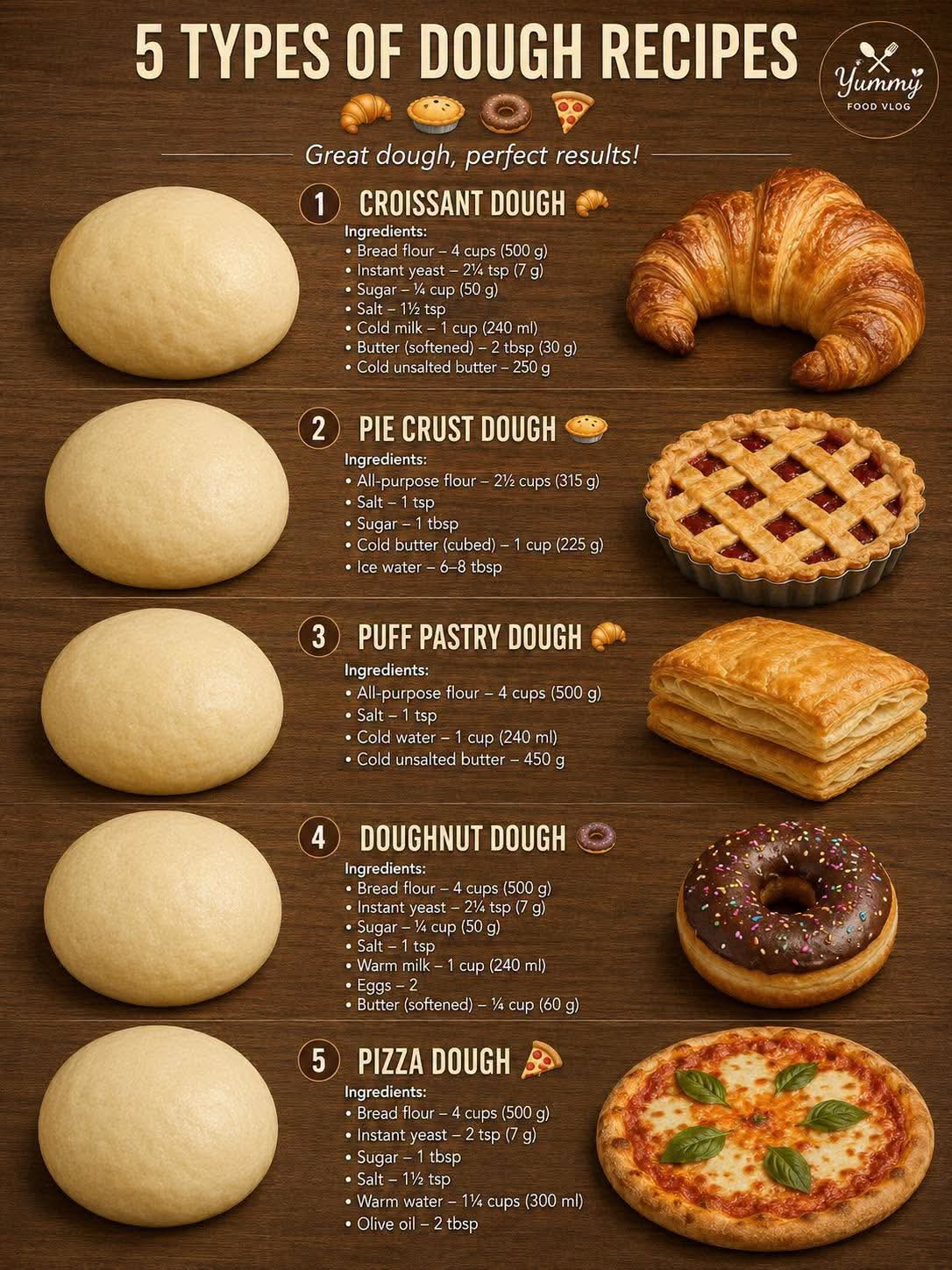
Here’s a complete guide to 5 essential dough recipes — from buttery croissants to crispy pizza crust. Each dough has its own history, structure, method, and purpose in baking. Mastering these gives you the foundation for countless pastries, breads, and desserts.
The Art of Dough Making
Dough is one of the oldest culinary creations in human history. It began thousands of years ago when early civilizations mixed grain with water to create simple flatbreads. Over time, techniques evolved into layered pastries, rich fried doughs, and artisan breads.
The secret of great dough lies in understanding gluten formation, fat distribution, hydration, fermentation, and temperature control.
1. Dough
Introduction
Croissant dough is famous for its buttery layers and delicate crisp texture. It is one of the finest examples of laminated dough.
History
The croissant originated in Austria as the kipferl before being perfected in France during the 19th century.
Ingredients
- Bread flour — 4 cups (500g)
- Instant yeast — 2¼ tsp
- Sugar — ¼ cup
- Salt — 1½ tsp
- Cold milk — 1 cup
- Softened butter — 2 tbsp
- Cold unsalted butter — 250g (for layering)
Formation Method
Croissant dough uses lamination:
- Dough layer
- Butter layer
- Folding repeatedly
- Creates hundreds of flaky layers
Instructions
Step 1: Make the Dough
Mix flour, yeast, sugar, and salt.
Step 2: Add Liquids
Pour in milk and softened butter.
Step 3: Knead
Knead 8–10 minutes until smooth.
Step 4: Chill
Rest in fridge for 2 hours.
Step 5: Laminate
Place butter inside and fold 3 times.
Step 6: Shape
Cut triangles and roll.
Step 7: Proof
Rise until fluffy.
Step 8: Bake
Bake at 200°C for 20 minutes.
Lovers of Croissants
People love croissants for:
- Breakfast sandwiches
- Sweet fillings
- Chocolate croissants
- Almond croissants
2. Crust Dough
Introduction
Pie crust is tender, buttery, and crumbly. The goal is minimal gluten.
History
Ancient Egyptians made early pie shells mainly as edible containers.
Ingredients
- All-purpose flour — 2½ cups
- Salt — 1 tsp
- Sugar — 1 tbsp
- Cold butter — 1 cup
- Ice water — 6–8 tbsp
Formation Method
Pie crust relies on:
- Cold fat
- Minimal mixing
- Proper chilling
Instructions
- Mix flour, sugar, salt.
- Cut in butter.
- Add ice water gradually.
- Form dough.
- Chill 1 hour.
- Roll out.
- Fill and bake.
Best For
- Apple pie
- Pumpkin pie
- Berry pie
- Savory quiche
3. Dough
Introduction
Puff pastry is the king of flaky doughs. It creates dramatic rise through steam.
History
Invented in France around the 1600s.
Ingredients
- Flour — 4 cups
- Salt — 1 tsp
- Cold water — 1 cup
- Cold butter — 450g
Formation Method
Requires 6 folds for thousands of layers.
Instructions
- Mix flour and salt.
- Add water.
- Knead lightly.
- Chill.
- Add butter block.
- Fold repeatedly.
- Chill between folds.
- Bake.
Loved For
- Turnovers
- Napoleons
- Sausage rolls
- Tarts
4. Dough
Introduction
Soft, fluffy, and rich — doughnut dough is a sweet yeast dough.
History
Dutch settlers brought early doughnuts to America in the 1800s.
Ingredients
- Bread flour — 4 cups
- Instant yeast — 2¼ tsp
- Sugar — ¼ cup
- Salt — 1 tsp
- Warm milk — 1 cup
- Eggs — 2
- Butter — ¼ cup
Formation Method
Enriched dough means:
- More fat
- Softer crumb
- Rich flavor
Instructions
- Mix dry ingredients.
- Add milk and eggs.
- Add butter.
- Knead.
- Rise.
- Shape.
- Rise again.
- Fry.
Doughnut Lovers
Popular styles:
- Glazed
- Chocolate
- Filled
- Sugar-coated
5. Dough
Introduction
Pizza dough is simple but powerful. It forms chewy, airy crusts.
History
Originated in , Italy, where modern pizza was born.
Ingredients
- Bread flour — 4 cups
- Instant yeast — 2 tsp
- Sugar — 1 tbsp
- Salt — 1½ tsp
- Warm water — 1¼ cups
- Olive oil — 2 tbsp
Formation Method
Pizza dough uses fermentation for flavor development.
Instructions
- Mix dry ingredients.
- Add water and oil.
- Knead.
- Let rise.
- Divide.
- Shape.
- Add toppings.
- Bake.
Pizza Lovers’ Favorites
- Margherita
- Pepperoni
- Veggie
- Cheese stuffed crust
Universal Dough Tips
✔ Always weigh ingredients for accuracy
✔ Cold butter = flaky dough
✔ Warm liquids = active yeast
✔ Resting develops texture
✔ Over-kneading can toughen dough
✔ Proper fermentation improves flavor
Conclusion
Dough is the backbone of baking. Whether you want flaky croissants, crispy pies, airy doughnuts, buttery puff pastry, or chewy pizza crust, understanding the method behind each one gives you endless possibilities in the kitchen.
The beauty of dough is transformation: simple ingredients become extraordinary food through time, patience, and technique. Every baker falls in love with dough because it turns flour, water, and butter into something unforgettable.