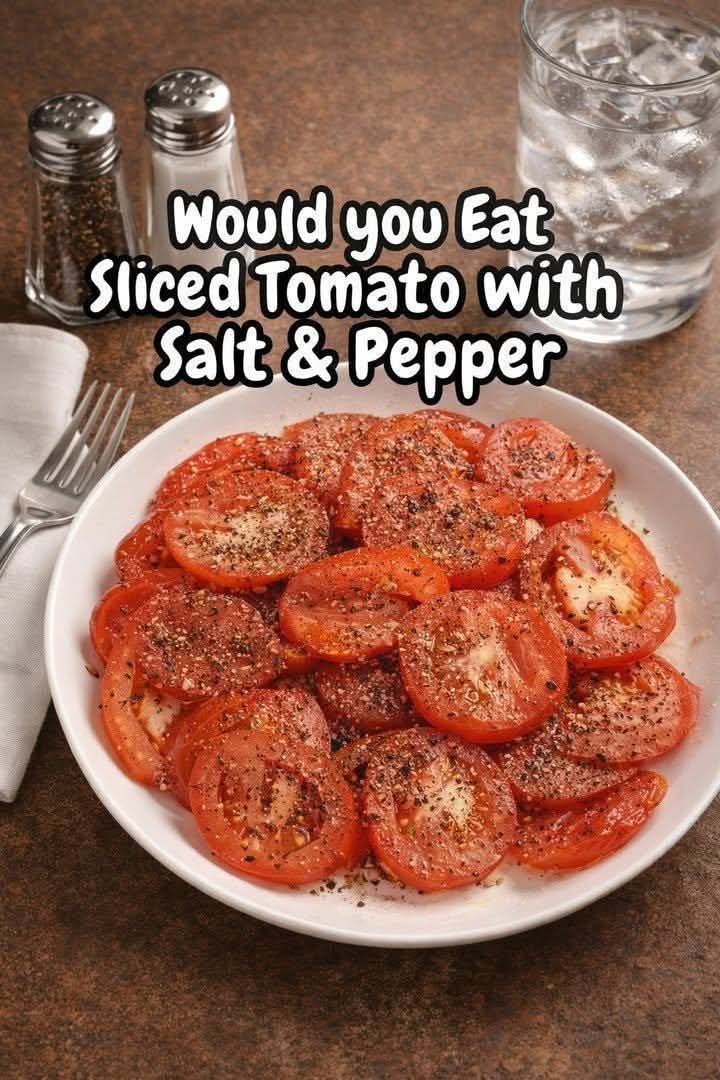
Here is a comprehensive exploration of the simple yet sublime dish, Sliced Tomato with Salt & Pepper, presented as a “big recipe” with all the elements you requested.
—
The Philosophy of Simplicity: Sliced Tomato with Salt & Pepper
Introduction
In a world of complex culinary techniques and multi-ingredient gastronomy, there exists a dish so pure, so fundamental, that it transcends the very definition of a “recipe.” Sliced Tomato with Salt & Pepper is not merely a side dish; it is a celebration of a single ingredient at its absolute peak. This dish is a testament to the belief that the role of a cook is not to transform nature, but to act as its messenger. It is the quintessential summer plate—a vibrant, juicy, and honest expression of flavor where the sweet acidity of a ripe tomato is elevated by the mineral crunch of salt and the aromatic heat of freshly ground pepper. This is not just food; it is an edible meditation on simplicity.
—
History
The history of sliced tomatoes seasoned with salt and pepper is not found in ancient cookbooks or royal courts; it is the history of agriculture and the universal human palate. While the tomato originated in western South America and was domesticated in Mexico, its journey to global cuisine was slow. For centuries in Europe, it was considered an ornamental, even poisonous, plant. It wasn’t until the 18th and 19th centuries in Italy and the American South that the tomato shed its suspicious reputation and became a staple.
The practice of slicing and seasoning it is a folk tradition born from abundance. When tomatoes ripen in the summer faster than they can be cooked into sauces, the simplest solution is to eat them raw. In the American South, it became a cornerstone of “mater sandwich” culture. In Italy, it is the heart of insalata di pomodoro—tomatoes with salt, pepper, olive oil, and perhaps basil. This dish represents a post-Industrial Revolution shift toward appreciating raw, whole foods. It gained further prominence in the 20th century with the rise of the “raw food” movement and the emphasis on terroir, becoming a standard that separates a truly great cook from a merely competent one: the willingness to let an ingredient speak for itself.
—
Benefits
Beyond its culinary virtues, this dish offers a wealth of benefits:
· Nutritional Powerhouse: Tomatoes are rich in lycopene, a powerful antioxidant linked to reduced risk of heart disease and certain cancers. Interestingly, while cooking concentrates lycopene, consuming raw tomatoes with a small amount of fat (like olive oil, if added) aids in its absorption. They are also an excellent source of Vitamin C, potassium, and Vitamin K.
· Hydration: With a water content of over 94%, this dish is exceptionally hydrating, making it perfect for hot weather.
· Digestive Health: The simple combination of fresh produce and salt aids digestion. Salt helps stimulate gastric juices, while the fiber in tomatoes promotes gut regularity.
· Mindful Eating: At a psychological level, the act of preparing and savoring this dish encourages mindfulness. It forces a pause to appreciate quality, flavor, and the moment, combating the mindless consumption often associated with modern eating.
—
Nutrition (Per Serving, based on 3-4 tomatoes divided among 4 servings)
· Calories: ~35
· Total Fat: 0.5 g
· Sodium: 290 mg (varies with salt addition)
· Total Carbohydrates: 8 g
· Dietary Fiber: 2 g
· Sugars: 5 g (natural)
· Protein: 1.5 g
· Vitamin C: 30% of Daily Value (DV)
· Vitamin A: 25% of DV
· Potassium: 10% of DV
—
Ingredients: The Sacred Trinity
The quality of these three ingredients is non-negotiable. Compromise here will yield a forgettable dish; honor them, and you will create a masterpiece.
· 3–4 ripe tomatoes: This is the star. Seek out tomatoes that are heavy for their size, fragrant, and yield slightly to gentle pressure. Heirloom varieties (like Brandywine, Cherokee Purple, or Green Zebra) offer complex, sweet, and acidic profiles that transform the dish. If heirlooms are unavailable, vine-ripened tomatoes are the next best choice. Avoid pale, hard, out-of-season hothouse tomatoes.
· 1/2 teaspoon salt (or to taste): Use a high-quality salt. Maldon sea salt flakes or another flaky sea salt are ideal. Their large, irregular crystals provide a delicate crunch and a clean salinity that dissolves on the tongue. Kosher salt is a good alternative. Table salt is too harsh and one-dimensional.
· 1/2 teaspoon freshly ground black pepper: Pre-ground pepper is a travesty in this dish. Whole peppercorns (Tellicherry or Lampong are excellent) must be ground coarsely just before serving. The volatile oils released by fresh grinding provide a piney, floral heat that is essential to cutting through the tomato’s sweetness.
—
Methods & Instructions (Two Approaches)
Method 1: The Classic Approach (Simple & Direct)
1. Preparation: Rinse the tomatoes under cool water and pat them completely dry with a paper towel. Moisture on the skin dilutes flavor.
2. Slicing: Using a serrated knife (a bread knife works best to avoid crushing the delicate flesh), slice the tomatoes into even rounds, approximately ¼ to ½ inch thick. Remove the small, tough core from the top of each tomato.
3. Plating: Arrange the slices on a shallow, non-reactive plate (ceramic, glass, or wood). Overlapping slightly is fine, but avoid piling them, as this can lead to uneven seasoning.
4. Seasoning: Sprinkle the salt evenly over all the slices from a height to ensure even distribution. Wait for 2-3 minutes. This crucial step allows the salt to draw out the tomato’s juices, creating a natural, savory “sauce” on the plate.
5. Finishing: Just before serving, grind the black pepper generously over the top. Serve immediately with a spoon to allow enjoyment of the accumulated juices.
Method 2: The Marinated Approach (Elevated & Infused)
1. Slice & Layer: Follow steps 1 and 2 above. Arrange the slices in a single, slightly overlapping layer on a large platter.
2. Season & Infuse: Sprinkle with salt. Add the freshly ground pepper. For this method, drizzle 1 tablespoon of high-quality extra virgin olive oil and a splash of red wine vinegar or fresh lemon juice over the tomatoes.
3. Rest: Allow the tomatoes to sit at room temperature for 15-30 minutes. This gentle marination allows the flavors to meld, the olive oil to mellow the acidity, and the tomatoes to release more of their flavorful juices.
4. Garnish & Serve: Optionally, add a few torn fresh basil leaves or a sprinkle of chopped chives. Serve with a crusty baguette to soak up the herb-infused juices at the bottom of the platter.
—
Formation (The Culinary Science)
The “formation” of this dish is a study in simple chemistry. The application of salt (sodium chloride) performs an osmotic process. It draws water molecules out of the tomato’s cells through the process of osmosis. This not only concentrates the remaining flavors (sugars, acids, and glutamates) but also creates a pool of savory liquid—the tomato water—which acts as a natural sauce. The fat-soluble compounds in black pepper, specifically piperine, are released by the act of grinding and are then carried by the tomato’s natural juices, allowing them to coat the palate more effectively. This interaction creates a flavor profile that is greater than the sum of its parts.
—
Lovers of the Dish
This dish is beloved by a diverse array of individuals united by a respect for purity:
· Farmers & Gardeners: For them, it is the ultimate reward for months of labor. The first ripe tomato of the season, sliced and salted, is a sacred ritual.
· Minimalist Chefs: Figures like Alice Waters (of Chez Panisse) built a culinary revolution on this principle. The philosophy that “if an ingredient doesn’t taste good raw and simply seasoned, it shouldn’t be cooked” is central to farm-to-table cuisine.
· Home Cooks: It is a beloved staple for its lack of fuss. It’s the go-to summer side for busy parents, the elegant appetizer for an impromptu dinner party, and a nostalgic comfort food for many.
· Health-Conscious Eaters: It is celebrated for being a nutrient-dense, whole-food option that satisfies without guilt.
· Purists: Individuals who believe that culinary skill is defined by restraint and the ability to elevate an ingredient without obscuring it.
—
Conclusion
Sliced Tomato with Salt & Pepper is more than a recipe; it is a culinary ethos. It strips away the superfluous and forces a confrontation with quality. It teaches that the greatest skill in the kitchen is often knowing when to step back. In a single bite, you experience the sun, the soil, the rain, and the simple, profound act of seasoning. It is a dish that is simultaneously a humble snack, a sophisticated appetizer, a nutritional ally, and a historical artifact of our relationship with food. To make it is to understand that sometimes, the most profound statement is also the simplest.
—
Lovers (A Final Tribute)
In conclusion, the true lovers of this dish are those who understand that cooking is an act of love. They are the grandmothers who grew their own tomatoes, the farmers who wake before dawn, the chefs who search for the perfect varietal, and the diner who closes their eyes in appreciation at the first bite. These lovers know that this dish isn’t made; it is revealed. It is a shared language of appreciation, a connection to the earth, and a timeless reminder that the best things in life—like a perfect tomato—require very little to be extraordinary.