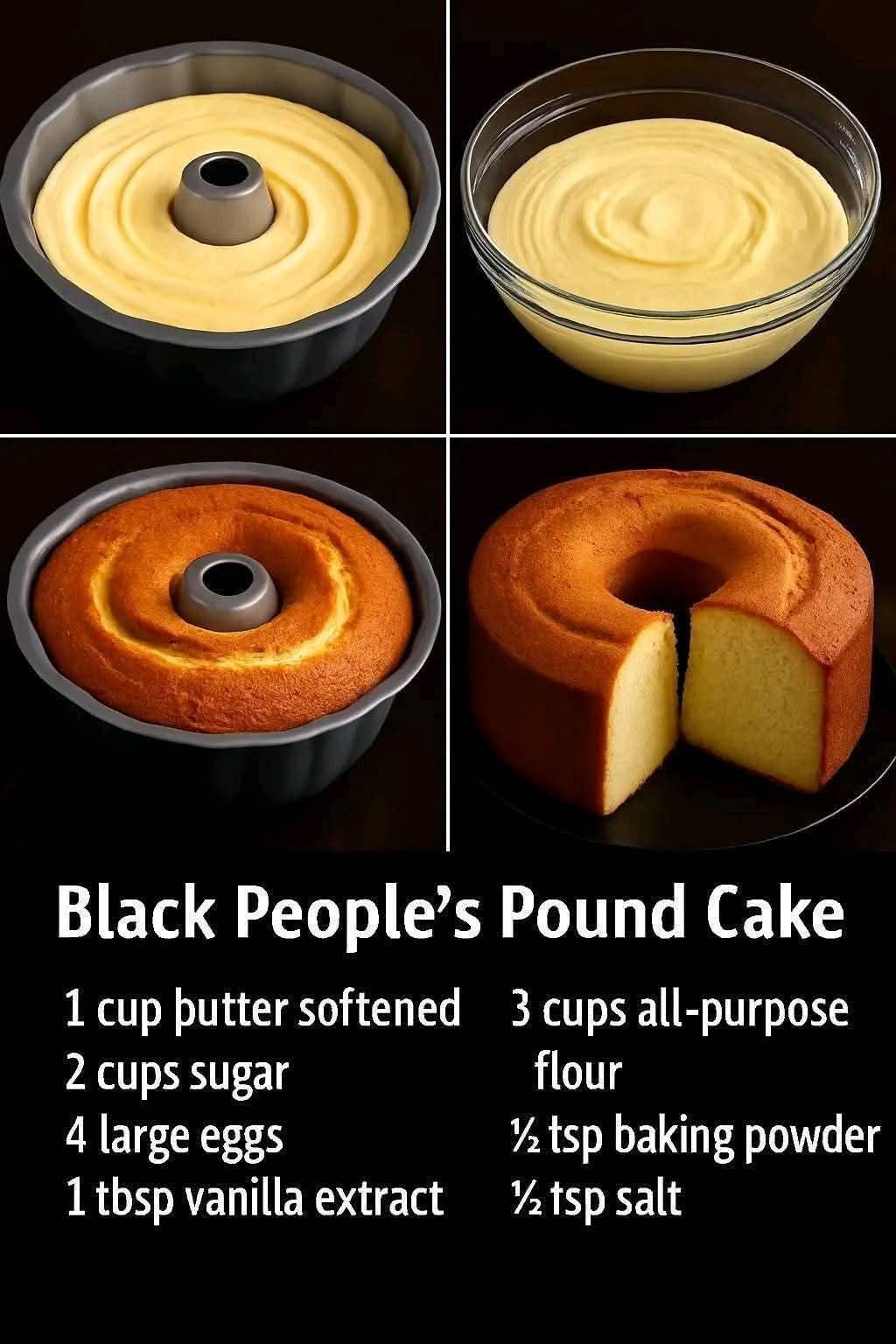
Here is a big, comprehensive guide to Black People’s Pound Cake, featuring the recipe you requested along with its rich history, cultural significance, and tips for success.
—
The Ultimate Guide to Black People’s Pound Cake: A Legacy of Love on a Plate
Introduction
In the tapestry of African American culinary tradition, few desserts hold as sacred a place as the pound cake. It is far more than a mere confection; it is a cultural artifact, a symbol of celebration, comfort, and familial love. Often referred to affectionately within the community as “Black People’s Pound Cake,” this dense, buttery, and impossibly moist cake is the unofficial dessert of Black America . It is the first dish to disappear from the table at family reunions, the reliable favorite at Sunday dinners, the gift sent to comfort a grieving friend, and the centerpiece at baby showers and graduation parties . Its presence is so ubiquitous that it’s often simply… there, a comforting constant in the kitchen that signals home .
This recipe is more than a list of ingredients; it is a legacy passed down through generations. While the original European pound cake relied on the simple formula of a pound each of flour, butter, eggs, and sugar, the version cherished in Black households has evolved into something transcendent . Through the hands of masterful bakers—many of whom learned from grandmothers and aunties who never used a written recipe—this cake has been refined. The addition of vanilla, a touch of baking powder for lift, and the crucial technique of creaming butter and sugar until your arm aches have transformed a humble loaf into a soulful experience .
This guide provides not only a beloved, time-tested recipe but also explores the deep history, the spiritual connection, and the communal joy baked into every slice. Prepare to create a cake that doesn’t just taste good—it feels like a warm embrace.
The History: From European Kitchens to Gullah-Geechee Soul Food
The story of the pound cake begins in Northern Europe, with the first published recipe appearing in Hannah Glasse’s 1747 cookbook, “The Art of Cookery, Made Plain and Easy,” which called for a pound of butter, a pound of eggs, a pound of sugar, and a pound of flour . However, its journey through the African American experience is where it gained its soul.
Enslaved Africans, who were forced to be the primary cooks in the kitchens of the antebellum South, took these basic recipes and imbued them with their own techniques and sensibilities . Working with what they had, and often taking leftover or discarded ingredients, they transformed simple provisions into extraordinary cuisine . This act of creation in the face of oppression was a form of resistance and cultural preservation. In the isolated Sea Islands of the South Carolina and Georgia Lowcountry, the Gullah-Geechee people—descendants of enslaved Africans who preserved much of their African heritage—elevated the pound cake to a cultural treasure .
For the Gullah-Geechee, the pound cake became intertwined with spirituality and storytelling. As Ron Daise, cultural preservationist and star of “Gullah Gullah Island,” explains, “The idea of pound cake inspires us. It stays with our bodies and shares our experiences” . Daise, who now runs GullahliciousCakes, includes a Gullah prayer with every cake he sells: “Gawd, bless ebbyboddy wha nyam disya cake from dey haid down to dey toe” (God, bless everyone who eats this cake from their head down to their toe) . This ritual underscores that the cake is not just food; it is a spiritual medium, a vessel for faith, heritage, and history.
Over time, as Black families migrated and settled across the country, the pound cake traveled with them. It became a symbol of economic empowerment; skillful bakers would sell their cakes in barbershops and beauty salons, turning a family recipe into a small business—a tradition that continues today with modern Black-owned bakeries shipping these classic cakes nationwide . The recipe was rarely written down, passed instead through observation and shared experience, which is why no two family pound cakes are exactly alike. As one baker put it, “It’s like music. You take one sound and make it your own. That’s how cooking is to us” .
The Cultural Significance: More Than a Dessert
To understand the importance of this cake, one must understand its role in the community. It is the great unifier at every major life event. Deaconess Deena Williams of Greater Victory Church in Lorain, Ohio, shared that her mother’s baking skills “was the glue that held our family together” . This sentiment is echoed across the diaspora.
· Celebration: From christenings and weddings to graduations and anniversaries, a pound cake is a signal that something important is happening .
· Comfort: In times of loss or hardship, a homemade pound cake appears on doorsteps. It’s a tangible way of saying, “I’m thinking of you,” without a word. As one auntie explained, it’s “the ultimate comfort food” .
· Connection: For many, the taste of a specific pound cake can transport them back to their grandmother’s kitchen. It’s a nostalgic link to ancestors and a way to keep their memory alive. The Post and Courier notes that the cake often “arrives accompanied by a story: a tale passed down through generations, usually tracing its origins back to the matriarch of the family” .
· Pride: There is immense pride in perfecting a pound cake. A “good” pound cake—with its dense, moist crumb and crackly, golden crust—is a badge of honor. Bakers are known to be perfectionists; as one shared, “And no butter streak! I’ll throw the whole cake away if I cut a cake and see that streak” .
Benefits of Baking This Recipe
Why should you make this particular pound cake?
1. Cultural Connection: You are not just baking a cake; you are participating in a tradition that has bound families and communities together for centuries.
2. Soulful Satisfaction: The rich, buttery flavor and dense, moist texture are profoundly satisfying in a way that lighter, airier cakes are not. It is comfort food at its finest.
3. Versatility: It is perfect on its own, with a dusting of powdered sugar, or dressed up with fresh berries, whipped cream, or a simple glaze. It also freezes beautifully, allowing you to have a slice of comfort whenever you need it .
4. Crowd-Pleaser: This is a guaranteed hit at any gathering. Its familiar flavor evokes nostalgia and warmth in those who grew up with it, and it introduces newcomers to a quintessential taste of Southern Black culture.
The Recipe: Black People’s Pound Cake
After reviewing numerous cherished recipes from family kitchens and reputable food blogs, this version synthesizes the most common and beloved elements. It uses cream cheese, a popular addition in many Black households, for an extra-tender crumb and rich flavor .
Introduction
Get ready to fill your home with an irresistible aroma and create a dessert that will be requested again and again. This recipe yields a tall, golden-brown cake with a perfectly dense crumb and a delicate, crackly top. It’s the one recipe you’ll want to pass down for generations to come—so don’t lose it!
Ingredients
Make sure all your ingredients, especially the butter, cream cheese, and eggs, are at room temperature. This is the most important secret to a smooth, well-emulsified batter that bakes up perfectly.
Ingredient Quantity Notes
Unsalted Butter 1 ½ cups (3 sticks) Softened to room temperature
Cream Cheese 8 oz (1 block) Full-fat, softened
Granulated Sugar 3 cups
Large Eggs 6 Room temperature
All-Purpose Flour 3 cups Spooned and leveled
Baking Powder ½ teaspoon
Salt ½ teaspoon Fine salt
Vanilla Extract 1 tablespoon Pure, not imitation
(Optional) Lemon/ Almond Extract ½ teaspoon For a subtle flavor twist
Note: This ingredient list is a synthesis of the most common and highly-rated versions .
Equipment Needed
· 10-inch Bundt pan or Tube pan
· Large mixing bowls
· Hand mixer or stand mixer with a paddle attachment
· Rubber spatula
· Measuring cups and spoons
· Wire cooling rack
· Toothpick or long skewer
Instructions & Methods
Prep Work (The Foundation for Success)
1. Position Racks and Preheat: Position a rack in the center of your oven and preheat it to 325°F (163°C) . A low and slow bake is essential for a dense, moist cake with a great crust.
2. Prepare the Pan: Generously grease and flour a 10-inch Bundt or tube pan. Do not skip this step! Use a pastry brush to coat every nook and cranny with softened butter or baking spray, then add a few tablespoons of flour and toss it around to coat the butter completely. Tap out the excess .
The Creaming Method (Building the Structure)
1. Cream Fats and Sugar: In a large bowl, beat the softened butter and cream cheese together until smooth and fluffy, about 2-3 minutes . Gradually add the sugar, and continue beating for another 3-5 minutes. This step is non-negotiable. You are mechanically creating air pockets that will expand in the oven, giving the cake its lift. The mixture should become very light in color and texture, almost like a fluffy frosting .
2. Incorporate Eggs: Add the eggs one at a time, beating well after each addition (about 30 seconds each). This ensures a smooth emulsion. Scrape down the sides and bottom of the bowl with a spatula after every few eggs to ensure everything is evenly mixed . Beat in your vanilla (and other extracts, if using).
3. Combine Dry Ingredients: In a separate, medium bowl, whisk together the flour, baking powder, and salt. Whisking aerates the flour and ensures the leavening and salt are evenly distributed .
The Final Mix (Be Gentle)
1. Alternate Adding Dry and Wet: With the mixer on low speed, gradually add the dry ingredients to the butter mixture. Many recipes suggest alternating with a liquid, but this cream cheese version relies on the moisture from the butter, cream cheese, and eggs. If the batter seems very stiff, you can add a tablespoon of milk, but it should be thick and velvety. Mix only until just combined. Overmixing develops the gluten in the flour, which will result in a tough, rubbery cake .
2. Final Fold: Remove the bowl from the mixer. Use your rubber spatula to give the batter a few final folds from the bottom up. This ensures no pockets of flour are hiding and incorporates everything evenly.
3. Fill the Pan: Spoon the thick batter into the prepared pan and smooth the top with your spatula. Give the pan a few gentle taps on the counter to release any large air bubbles trapped in the batter .
The Bake (Patience is a Virtue)
1. Bake: Place the pan in the preheated oven and bake for 75 to 95 minutes . Baking time can vary depending on your oven and pan. The cake is done when:
· The top is a deep golden brown and has developed a characteristic crack or two.
· A long toothpick or skewer inserted into the center comes out with just a few moist crumbs attached (not wet batter) .
· An instant-read thermometer inserted into the center reads 200-210°F .
2. Cool in the Pan: If the cake is browning too quickly after an hour, tent it loosely with aluminum foil. Once done, place the pan on a wire rack and let it cool in the pan for 15 minutes. This is critical; if you try to turn it out too soon, it may fall apart .
The Grand Finale
1. Unmold and Cool Completely: Place the wire rack on top of the cake pan. Using oven mitts, hold the pan and rack firmly together and invert the whole thing. Gently lift the pan off. You should have a perfectly formed cake. If any part sticks, gently coax it out with a thin spatula. Allow the cake to cool completely on the wire rack before slicing . Slicing it warm will cause it to crumble.
Serving Suggestions & Variations
· Classic: Serve it plain to appreciate its buttery flavor. A cold glass of milk is the traditional accompaniment.
· Dressed Up: Dust with powdered sugar, or top with fresh macerated strawberries and homemade whipped cream .
· Glazed: Drizzle with a simple vanilla or lemon glaze (mix 1 cup powdered sugar with 1-2 tablespoons of milk or lemon juice).
· Flavor Twists: As noted in the ingredients, you can add lemon, almond, or even coconut extract for a different flavor profile . For a holiday version, fold in a teaspoon of nutmeg or a half-cup of finely chopped pecans .
Nutritional Information
Please note that these are estimates and can vary based on specific ingredients and portion sizes. Based on a standard recipe yielding 16 slices :
Nutrient Approximate Value per Slice
Calories 420-450
Fat 22g
Saturated Fat 13-14g
Carbohydrates 48-58g
Sugar 30-35g
Protein 6g
Cholesterol 110-125mg
Sodium 170-250mg
Conclusion: A Taste of Heaven
Black People’s Pound Cake is more than the sum of its ingredients. It is a edible embodiment of history, resilience, love, and community. It’s the cake that holds memories of Sunday suppers, the taste of a grandmother’s kitchen, and the feeling of being surrounded by family. When you pull this golden, fragrant cake from your oven, you are not just a baker; you are a keeper of the flame, a creator of new memories for your own loved ones.
So, as the recipe says, don’t lose this recipe. Write it down, share it, and most importantly, bake it. Let the slices be a vehicle for conversation, for laughter, and for connection. Whether it’s for a celebration or just a Tuesday night, this cake is a reminder that some of the best things in life are made from scratch and shared with love.
For the Lovers of Pound Cake
This cake is for the aunties who never need a recipe, the grandfathers who sneak a slice late at night, the cousins who fight over the crispy crust, and the friends who become family. It is for the ones who know that a homemade cake says “I love you” louder than any words can. It is for the preservationists, like Ron Daise, who pray over their cakes, and the entrepreneurs, like the owners of Moody Treats and Dee-Licious Pound Cakes, who turn tradition into sweet success . It is for anyone who understands that food is love, and that a simple pound cake, baked with care, can be a bridge to the past and a gift to the future. Now, preheat your oven and get ready to create a little bit of magic.