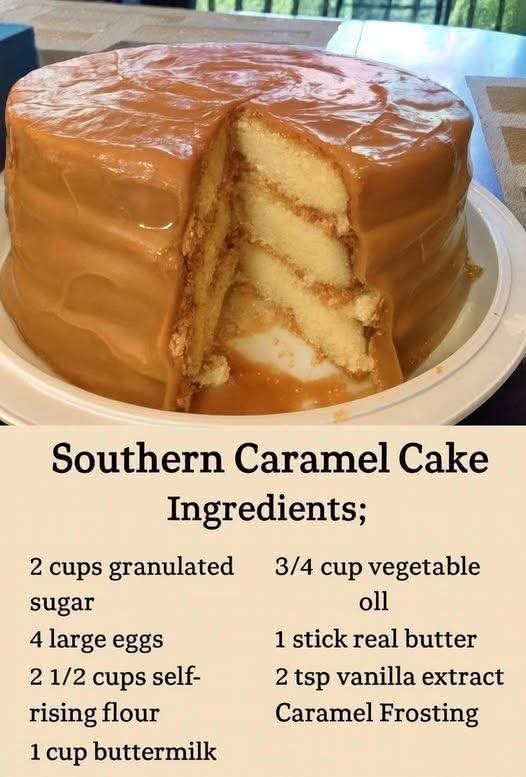
Here is a comprehensive guide to Southern Caramel Cake, crafted to honor your request for a “big recipe” with all the details you’ve asked for.
The Quintessential Southern Caramel Cake: A Slice of Heaven
Introduction
Few desserts capture the heart and soul of the American South quite like a Southern Caramel Cake. This is not merely a dessert; it is a edible memory, a symbol of hospitality, and a centerpiece for life’s most cherished gatherings . Imagine a tall, stately cake with multiple layers of tender, buttery crumb, all enrobed in a glossy, amber-hued caramel frosting that is both sticky and sublime. This is a cake that demands patience and rewards it with an unparalleled depth of flavor—a deep, toasted sugar sweetness that is far more complex than any confectioner’s sugar buttercream could ever be .
This guide is your all-access pass to creating this Southern icon in your own kitchen. We will journey through its surprising history, break down the function of every ingredient, and provide you with a fail-proof, detailed recipe to ensure your caramel cake is a show-stopping success. Whether you are a seasoned baker or a brave novice, prepare to fall in love with a dessert that has been warming hearts and homes for generations.
The History of Southern Caramel Cake
The story of the Southern Caramel Cake is a delicious tale of culinary evolution and cultural adaptation. Its roots can be traced back across the Atlantic to the Dobostorte, a famous Hungarian layer cake from the late 1800s known for its thin layers and caramel glaze. As European immigrants settled in America, they brought their sophisticated cake-making techniques with them .
By the late 19th and early 20th centuries, the concept of the multi-layered cake had merged with local ingredients and tastes in the American South. The region was rich in sugar and dairy, and resourceful home cooks began experimenting . Instead of the European-style glazes, they started creating a distinctly American version: a soft, buttery cake slathered with a thick, cooked frosting made from brown sugar, butter, and milk. One of the first printed recipes for a “Caramel Cake” appeared in 1883 in “The Dixie Cook-Book” by Estelle Woods Wilcox, cementing its place in culinary history .
For Southern families, this cake quickly became more than just a recipe; it became a treasured heirloom, passed down from grandmother to mother to daughter on handwritten recipe cards . It was the cake baked for Sunday supper, birthday celebrations, church socials, and even comforting gatherings after funerals . To bake a caramel cake was to show love, and to eat one was to “preserve a slice of the past” .
What Makes it Special? A Cake for the Lovers of Good Food
For the true dessert lover, the Southern Caramel Cake is the holy grail. Its appeal lies in its beautiful contrasts:
· Texture: The cake layers are incredibly moist and tender, often thanks to tangy buttermilk. This soft crumb is the perfect counterpart to the dense, rich, and slightly chewy frosting .
· Flavor: Unlike the one-note sweetness of many modern cakes, a true caramel cake offers complexity. The frosting has a deep, almost bittersweet caramelized sugar flavor with notes of toasted butter and vanilla, perfectly balanced by the simple, buttery sweetness of the cake itself .
· A Labor of Love: This is not a cake for a baker looking for a quick fix. The frosting, which must be cooked to the “soft-ball” stage on the stovetop, requires your full, undivided attention . This effort, however, is exactly what makes the final product so rewarding and meaningful. When you present this cake, you are not just serving dessert; you are sharing a piece of your time and care.
Ingredient Deep Dive: The Building Blocks of Perfection
To build the best cake, we must first understand our materials. Here is the role each ingredient plays in this symphony of flavor .
For the Cake Layers:
· Unsalted Butter (3 sticks / 1 ½ cups): The foundation of richness. Using unsalted butter allows you to control the overall salt level. It needs to be softened to room temperature to cream properly with the sugar, creating air pockets that give the cake its lift.
· Granulated Sugar (3 cups): Provides sweetness and, when creamed with butter, helps create a tender crumb.
· Eggs (5 large): These provide structure. They must be at room temperature to emulsify properly into the batter, ensuring a smooth, even texture.
· All-Purpose Flour (approx. 3 cups): Provides the structural framework. The exact amount will vary by recipe (some use self-rising), so measuring correctly (spooning into the cup and leveling off) is crucial.
· Buttermilk (1 cup): The secret to a moist, tangy, and tender cake. Its acidity tenderizes the gluten and reacts with baking soda for a perfect rise .
· Leavening Agents (Baking Powder & Baking Soda): These are non-negotiable for a light and fluffy layer cake.
· Vanilla Extract (2 teaspoons): Enhances all the warm, sweet flavors.
For the Caramel Frosting (The Star of the Show):
· Granulated & Brown Sugar: Many recipes use a combination. Brown sugar contains molasses, which contributes to a deeper, more complex caramel flavor and adds moisture .
· Unsalted Butter (1-2 sticks): Adds richness, flavor, and helps the frosting become smooth and glossy.
· Dairy (Milk, Half-and-Half, or Evaporated Milk): This creates the creamy base. Evaporated milk, with its concentrated, slightly caramelized flavor, is a favorite in many traditional recipes .
· Vanilla Extract & Salt: Vanilla deepens the caramel flavor, while a dash of salt is essential to cut through the sweetness and make the flavor sing .
The Recipe: A Step-by-Step Method to Caramel Cake Glory
This recipe synthesizes the best techniques from classic Southern kitchens . Remember, mise en place—having all your ingredients prepped and ready—is the key to success.
Yields: 12-15 servings | Prep time: 30 minutes | Cook time: 1 hour 15 minutes
Ingredients
For the Cake:
· 3 sticks (1 ½ cups) unsalted butter, softened, plus more for greasing pans
· 3 cups granulated sugar
· 5 large eggs, room temperature
· 3 cups all-purpose flour, plus more for dusting pans
· ½ teaspoon salt
· 1 teaspoon baking powder
· ½ teaspoon baking soda
· 1 cup buttermilk, room temperature
· 2 teaspoons vanilla extract
For the Caramel Icing:
· 1 cup unsalted butter
· 2 cups packed light brown sugar
· 1 cup granulated sugar
· 1 (12-ounce) can evaporated milk
· ½ teaspoon salt
· 2 teaspoons vanilla extract
Instructions
Part 1: The Cake Layers
1. Preheat and Prepare: Preheat your oven to 350°F (175°C). Grease and flour three 9-inch round cake pans. For extra insurance, you can line the bottoms with parchment paper rounds .
2. Cream Butter and Sugar: In a large bowl (or stand mixer with paddle attachment), beat the softened butter on medium speed until creamy. Gradually add the 3 cups of sugar and beat for 3-5 minutes, until the mixture is light, fluffy, and pale in color .
3. Add Eggs: Add the eggs one at a time, beating well after each addition until the yolk is fully incorporated. Stir in the vanilla extract.
4. Combine Dry Ingredients: In a separate medium bowl, whisk together the flour, salt, baking powder, and baking soda.
5. Alternate Additions: With the mixer on low speed, add the dry ingredients to the butter mixture in three additions, alternating with the buttermilk in two additions. Begin and end with the dry ingredients (e.g., flour, buttermilk, flour, buttermilk, flour). Mix just until combined after each addition. Do not overmix .
6. Bake: Divide the batter evenly among the three prepared pans. Bake for 25-35 minutes, or until a wooden toothpick inserted into the center comes out clean.
7. Cool: Let the cakes cool in the pans on a wire rack for 10-15 minutes. Then, carefully turn them out onto the rack to cool completely. The layers must be completely cool before you frost them, or the icing will melt .
Part 2: The Caramel Icing (The Moment of Truth)
1. Combine Ingredients: In a large, heavy-bottomed saucepan (at least 4-quart size), combine the butter, brown sugar, granulated sugar, evaporated milk, and salt .
2. Cook the Icing: Place the pan over medium heat and stir constantly until the butter is melted and the sugar is dissolved. Once the mixture comes to a gentle boil, clip a candy thermometer to the side of the pan. Continue to cook, stirring frequently, until the mixture reaches the soft-ball stage (235°F – 240°F) . This can take anywhere from 10 to 20 minutes.
· No thermometer? Use the cold water test: Drop a small spoonful of the hot syrup into a cup of very cold water. Let it cool for a moment, then fish it out. If you can roll it into a soft, pliable ball between your fingers, it’s ready .
3. Finish the Icing: Immediately remove the pan from the heat. Do not stir it. Let it cool for about 15-20 minutes in the pan. Then, stir in the vanilla extract.
4. Beat to Perfection: Transfer the slightly cooled mixture to the bowl of a stand mixer (or use a hand mixer). Beat on medium speed until the icing thickens and loses its glossy sheen, becoming a spreadable, creamy consistency. This can take 5-10 minutes. Be patient—it will happen !
Part 3: Assembly
1. Frost the Layers: Place one cake layer on your serving plate. Working quickly (as the icing will continue to set), spread a generous amount (about ½ cup) of icing over the top. Repeat with the second and third layers .
2. Frost the Sides and Top: Pour the remaining icing over the top of the cake and use a spatula to gently coax it down the sides, spreading to create an even coat. The icing is meant to look rustic and homey—a perfectly smooth finish is not the goal here .
3. Set and Serve: Allow the cake to sit for at least an hour to let the frosting fully set before slicing. Serve at room temperature for the best flavor and texture.
Tips for a Perfect Cake (Formation of a Masterpiece)
· Room Temperature is Rule #1: Your butter, eggs, and buttermilk must be at room temperature. This ensures they emulsify into a smooth, homogenous batter, creating a fine, even crumb .
· Don’t Rush the Frosting: Cooking caramel icing is a delicate process. Use medium heat and stir constantly to prevent scorching. Once it reaches the soft-ball stage, pull it off the heat immediately .
· Troubleshooting the Icing: If your icing gets too thick to spread, you can gently warm it over low heat or add a tablespoon of hot milk to loosen it up. If it’s too thin, let it cool and beat it a little more .
· Crumb Coat: If you’re worried about crumbs getting into your final frosting, apply a very thin layer of icing all over the cake first (this is the “crumb coat”). Pop the cake in the fridge for 15 minutes to set it, then apply the final, beautiful coat .
Variations: Making it Your Own
· Nutty Caramel Crunch: Fold a cup of toasted, chopped pecans into the finished frosting before icing the cake for a delightful textural contrast .
· Boozy Bourbon Caramel: Add 1-2 tablespoons of good bourbon to the frosting along with the vanilla for a warm, complex, adult-only kick .
· Salted Caramel Sensation: Sprinkle a little bit of flaky sea salt (like Maldon) over the top of the cake immediately after frosting. The salty crunch against the sweet, creamy icing is irresistible .
Storage & Make-Ahead Tips
· Storage: Store leftover cake in an airtight container at room temperature for up to 3 days. You can also refrigerate it for up to 5 days, but be sure to let slices come back to room temperature before serving to restore their tenderness .
· Make-Ahead: You can bake the cake layers a day in advance. Wrap them tightly in plastic wrap once completely cool and store at room temperature. The frosting must be made on the day you plan to serve the cake for the best consistency.
Nutritional Information (A Note on Indulgence)
A cake this glorious is meant for special occasions. Here is an approximate nutritional breakdown per slice (based on 15 servings), keeping in mind that these values are estimates and will vary by recipe :
Nutrient Approximate Amount per Slice
Calories 750-850 kcal
Total Fat 35-40g
Carbohydrates 110-125g
Sugar 90-105g
Protein 6-8g
This cake is high in sugar and saturated fat (primarily from butter), making it a rich dessert best enjoyed in moderation as part of a balanced lifestyle .
Conclusion: A Legacy in Every Bite
Baking a Southern Caramel Cake is a rite of passage. It is a project that connects you to generations of Southern bakers who stood over hot stoves, patiently stirring sugar and butter into a magical, golden elixir. The process requires attention and care, but the reward is immense: a stunning, unforgettable dessert that tastes of tradition, comfort, and love.
So go ahead, tie on your apron, and gather your ingredients. Don’t lose this recipe—treasure it. Make it for your family, for your friends, or just for the sheer joy of creating something beautiful. With every slice, you’ll be serving not just a cake, but a true taste of the South.