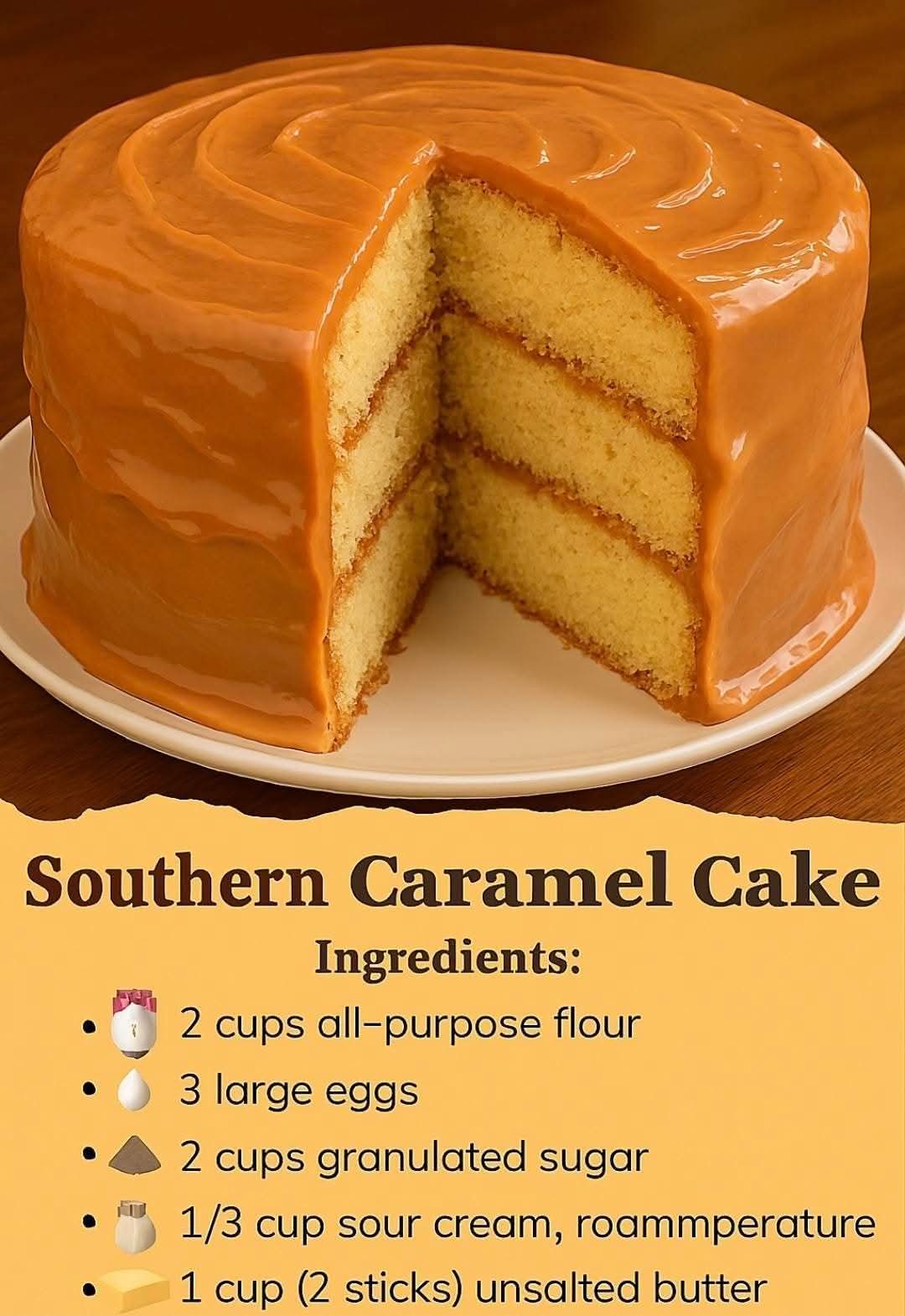
Here is a comprehensive guide to making a classic Southern Caramel Cake, transformed from your initial list of ingredients into a detailed recipe. This guide covers everything from its rich history to a step-by-step method for creating this beloved dessert.
Introduction: A Slice of Southern Sunshine
There are few desserts that capture the heart and soul of the American South quite like a Southern Caramel Cake. This isn’t just a cake; it’s an experience. Imagine biting into a tender, moist, and buttery crumb,
Southern Caramel Cake: A Slice of Southern Sunshine
A slice of Southern Caramel Cake on a vintage plate, showcasing its golden layers and rich, drippy caramel frosting .
It’s a dessert built on simple, humble ingredients—flour, sugar, butter, and eggs—that are transformed through patience and care into something truly spectacular. The star of the show is the luscious, cooked caramel frosting. Unlike a simple buttercream, this frosting is made by browning sugar on the stove, creating a deep, complex flavor that is both sweet and slightly smoky. It’s a testament to the Southern tradition of making something extraordinary from the everyday .
This cake is more than just food; it’s a centerpiece for life’s moments. For generations, it has graced tables at Sunday dinners, family reunions, holidays like Thanksgiving and Christmas, and even weddings . It’s a symbol of Southern hospitality and tradition, a recipe often passed down in worn-out handwriting from grandmother to grandchild, carrying with it the warmth and memories of home . In this guide, we will honor that tradition by walking you through everything you need to know to create this timeless classic in your own kitchen.
The History of Southern Caramel Cake
The story of the Southern Caramel Cake is a delicious journey through time, connecting ancient techniques to modern American kitchens. Its roots can be traced back to the caramelization of sugar itself.
The term “caramel” first appeared in English in 1725, stemming from the Latin word calamus, meaning sugar cane . While the Arabs are believed to have invented caramel candy around 1000 A.D., the soft, creamy caramel we know today is often considered an American creation. It’s thought to have been invented by accident in the mid-1800s when a cook added cream to plain sugar caramel, creating a much richer confection .
The journey to a layered cake, however, has European roots. The idea of multi-layered cakes is a descendant of the Hungarian-Austrian Dobostorte. This concept traveled across Europe to France and England, and as settlers arrived in the New World, they brought their cake-baking traditions with them. Over time, these evolved into regional American classics, with the South embracing the rich, sugar-laden caramel cake .
Food historians credit a Southern cook for the creation of the Caramel Cake as we know it, and it gained immense popularity from the late 1800s until the 1950s in the sugar-rich American South . It became a “historic and cultural delicacy,” a time-honored recipe passed down through generations . One of the first printed recipes for Caramel Cake appeared in 1883 in “The Dixie Cook-Book,” by Estelle Woods Wilcox . This cemented its place in culinary history, transforming it from a family secret to a regional treasure. When you eat this cake today, as one historian noted, you are “preserving a slice of the past” .
Ingredients Breakdown
The magic of a Southern Caramel Cake lies in the quality and function of its simple ingredients. Here’s what each component brings to this masterpiece.
For the Cake Layers
· All-Purpose Flour (2 ½ cups): This provides the structural foundation for the cake, creating a tender yet sturdy crumb that can support the heavy frosting . Sifting the flour is often recommended to incorporate air and prevent lumps, ensuring a lighter texture .
· Unsalted Butter (1 cup, softened): The heart of the cake’s richness and flavor. Using unsalted butter allows you to control the overall salt level in the recipe. The creaming process with sugar traps air, which is essential for a light and fluffy cake .
· Granulated Sugar (2 cups): Besides sweetening the cake, sugar helps to tenderize the gluten and retain moisture. When creamed with butter, the sharp sugar crystals help create air pockets, leading to a beautiful rise .
· Eggs (4 large, at room temperature): Eggs provide structure, stability, and moisture. The proteins in eggs help bind the batter, while the fats in the yolk add richness and a velvety texture. Using room-temperature eggs ensures they emulsify properly into the butter mixture without curdling .
· Buttermilk (1 cup, at room temperature): This is a secret weapon in Southern baking. Its slight acidity serves two crucial purposes: it tenderizes the gluten for an exceptionally soft crumb and activates the baking soda to help the cake rise beautifully. It also adds a subtle tang that balances the sweetness of the caramel .
· Baking Powder (1 ½ tsp) & Baking Soda (½ tsp): These are the leavening agents. Baking powder provides the main lift, while baking soda reacts with the acid in the buttermilk to create extra lightness and tenderness .
· Vanilla Extract (1 tbsp): A high-quality pure vanilla extract adds depth and enhances the warm, sweet flavors of both the cake and the frosting .
· Salt (½ tsp): An essential ingredient that doesn’t add saltiness but rather enhances all the other flavors and balances the overall sweetness .
For the Caramel Frosting
This is where patience and precision come into play. There are two primary methods for achieving that iconic Southern caramel flavor.
The Brown Sugar Method (Simpler):
· Brown Sugar (2 cups, packed): This is the shortcut to deep caramel flavor. Brown sugar is essentially white sugar with molasses added back in, giving it a built-in, mild caramel taste and extra moisture .
· Unsalted Butter (1 cup): The foundation for a rich, creamy, and silky frosting .
· Evaporated Milk or Heavy Cream (½ cup): This adds creaminess and helps create a smooth, pourable consistency that will set up firmly as it cools .
· Powdered Sugar (4 cups, sifted): Used to thicken the frosting to a spreadable consistency and add sweetness without grittiness .
· Vanilla Extract & Salt: For flavor enhancement and balance .
The Traditional “Burnt Sugar” Method (Classic):
· Granulated Sugar (for browning): This is the traditional method where white sugar is melted in a skillet until it becomes a deep, amber-colored liquid. This “burnt sugar” provides an incredibly pure, complex, and slightly bitter caramel note that is the hallmark of an authentic “real deal” cake . This browned sugar is then added to a boiling milk mixture.
Step-by-Step Instructions
Creating a Southern Caramel Cake is a labor of love. Follow these steps carefully for a show-stopping result.
Part 1: Preparing the Cake Layers
1. Preheat and Prepare: Preheat your oven to 350°F (175°C). Grease and flour two 9-inch round cake pans. For extra insurance, you can line the bottoms with parchment paper rounds .
2. Mix Dry Ingredients: In a medium bowl, whisk together the dry ingredients: 2 ½ cups all-purpose flour, 1 ½ tsp baking powder, ½ tsp baking soda, and ½ tsp salt. Set aside .
3. Cream Butter and Sugar: In a large bowl (or a stand mixer fitted with the paddle attachment), beat the softened butter (1 cup) and granulated sugar (2 cups) on medium-high speed until the mixture is light and fluffy. This should take about 3-5 minutes and is a crucial step for a tender cake .
4. Add Eggs and Vanilla: Add the eggs one at a time, beating well after each addition until the yolk is fully incorporated. Scrape down the sides of the bowl as needed. Then, mix in the vanilla extract (1 tbsp) .
5. Alternate Wet and Dry Ingredients: With the mixer on low speed, begin adding the dry ingredients in three parts, alternating with the buttermilk (1 cup). Start and end with the dry ingredients. This means: add 1/3 of the flour, then ½ of the buttermilk, then another 1/3 of the flour, then the rest of the buttermilk, and finally the last 1/3 of the flour. Mix until just combined after each addition. Overmixing at this stage will develop the gluten and result in a tough cake .
6. Bake the Layers: Divide the batter evenly between the two prepared pans and smooth the tops. Bake for 25-35 minutes, or until a toothpick inserted into the center comes out clean or with a few moist crumbs .
7. Cool Completely: Let the cakes cool in the pans on a wire rack for about 10-15 minutes. Then, carefully turn them out onto the wire rack to cool completely. Do not frost a warm cake, or the frosting will melt and slide right off .
Part 2: Making the Caramel Frosting (The Brown Sugar Method)
1. Combine Base Ingredients: In a medium, heavy-bottomed saucepan over medium heat, combine 1 cup unsalted butter and 2 cups packed brown sugar. Stir constantly until the butter is melted and the mixture is smooth and bubbly .
2. Add Dairy: Carefully whisk in ½ cup of evaporated milk or heavy cream. The mixture will bubble up vigorously. Continue to stir and bring it to a gentle boil. Let it boil for about 2-3 minutes without stirring, until it thickens slightly. Remove from the heat .
3. Incorporate Powdered Sugar and Flavor: Allow the mixture to cool for about 5-10 minutes. Then, gradually beat in the sifted powdered sugar (4 cups), about one cup at a time, until the frosting is smooth and has a thick, spreadable consistency. Stir in 1 tsp vanilla extract and a pinch of salt . If the frosting is too thick, you can add a tablespoon of milk to thin it out. If it’s too thin, let it cool a bit longer to thicken up .
Part 3: Assembling the Cake
1. Frost the First Layer: Place one completely cooled cake layer on your serving plate or cake stand. Use an offset spatula to spread a generous amount (about ½ to ¾ cup) of the caramel frosting evenly over the top .
2. Add the Second Layer: Gently place the second cake layer on top, making sure it’s level.
3. Frost the Entire Cake: Apply a thin “crumb coat” of frosting all over the cake to seal in any loose crumbs. If you have time, refrigerate the cake for 15-20 minutes to let this coat set. Then, use the remaining frosting to cover the top and sides of the cake. You can create swirls for a rustic look or try for smooth sides .
4. Set and Serve: Allow the cake to sit for at least 30 minutes to let the frosting firm up before slicing. This will make for much cleaner slices. For a final flourish, you can drizzle a little extra warm caramel sauce on top or sprinkle with flaky sea salt .
Benefits, Nutrition, and Conclusion
Benefits: More Than Just a Dessert
While it’s certainly a treat, a homemade Southern Caramel Cake offers benefits that go beyond simple nutrition. First and foremost, there is an emotional and cultural benefit. Baking this cake is a way to connect with heritage and continue family traditions. Sharing it is an act of Southern hospitality, a gesture of welcome, love, and celebration that brings people together . The process itself, from creaming the butter to watching the sugar caramelize, can be a mindful and rewarding experience, offering a sense of accomplishment that a store-bought dessert can never provide.
Nutritional Information
As a rich, indulgent dessert, this cake is best enjoyed in moderation as part of a balanced lifestyle. The following is an estimated nutritional profile for one slice (based on a cake serving 12-15 people) :
Nutrient Approximate Amount Per Slice
Calories 500-600 kcal
Total Fat 25-35g
Saturated Fat 15-20g
Cholesterol 80-120mg
Sodium 250-350mg
Total Carbohydrates 70-85g
Sugars 55-70g
Protein 5-7g
Note: These values are estimates and can vary significantly based on specific ingredient brands and portion sizes.
For those with dietary restrictions, there are ways to adapt the recipe. A gluten-free version can be made using a high-quality 1:1 gluten-free baking blend . A dairy-free option is more challenging but possible with plant-based butter, and a dairy-free milk like oat or almond milk mixed with a little lemon juice to mimic buttermilk .
Conclusion: A Taste of Love and Tradition
Mastering the Southern Caramel Cake is a true rite of passage for any baker. It’s a recipe that demands a little patience and a lot of love, but the reward is immeasurable. From the first sweet, nutty scent of caramel wafting through your kitchen to the moment you cut into those perfect, tender layers, you are participating in a delicious tradition that spans centuries.
This cake is for the lovers—lovers of Southern culture, lovers of time-honored recipes, and lovers of the people you share it with. It’s for the family gathered around a holiday table, for friends celebrating a milestone, and for anyone who understands that the best meals are made with care and shared with joy. So preheat your oven, gather your simple ingredients, and create not just a dessert, but a memory. As they say in the South, “When you eat this cake, you are preserving a slice of the past” . Happy baking