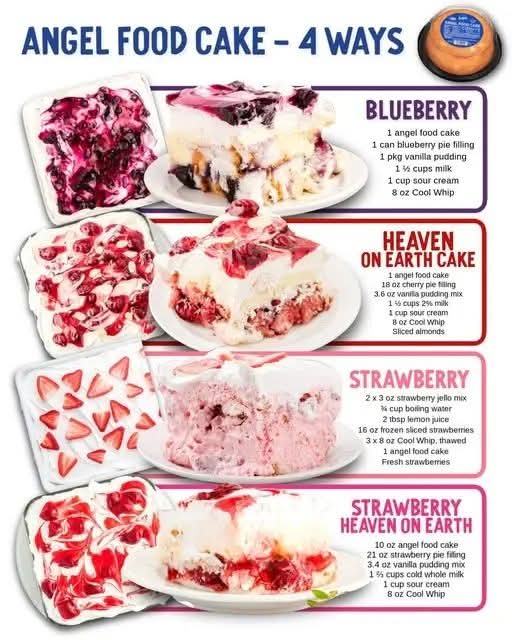
Here is a detailed guide to a classic and refreshing dessert, featuring a recipe for Blueberry Angel Food Cake. This comprehensive article covers everything from the recipe itself to the cake’s fascinating history and nutritional profile.
—
The Heavenly Delight: A Comprehensive Guide to Angel Food Cake with Blueberry Topping
Introduction
Sweet, soft, and ethereally light, angel food cake stands as a pillar of classic American desserts. Its name evokes a sense of purity and cloud-like texture, a reputation it has lived up to for nearly two centuries. Characterized by its snowy-white crumb and airy structure, this cake is a celebration of simplicity, transforming basic ingredients into something sublime .
Unlike its richer counterparts, angel food cake contains no butter or egg yolks, making it a uniquely low-fat treat . Its delicate crumb provides the perfect canvas for a myriad of toppings, from simple dustings of powdered sugar to rich chocolate sauces. However, it is perhaps most at home when paired with the bright, tangy sweetness of fresh fruit . This guide will not only walk you through a foolproof recipe for a spectacular Blueberry Angel Food Cake but also delve into the history, technique, and nutritional aspects of this beloved dessert. Whether you are a novice baker or a seasoned pro, the following pages will equip you with everything you need to create and appreciate this heavenly confection.
The History of Angel Food Cake
The story of angel food cake is a journey through American culinary history, with roots that reach back to the 19th century. Its origins are a subject of delightful lore. One popular story credits frugal Pennsylvania Dutch cooks with its invention, as they sought a way to use the numerous egg whites left over from making noodles and other baked goods . Another theory places its genesis further south, suggesting that the labor-intensive process of beating egg whites by hand may have been a task historically performed by enslaved people in Southern kitchens .
The earliest known ancestor of the modern angel food cake can be traced to a recipe for “White Sponge” in Lettice Bryan’s 1839 cookbook, The Kentucky Housewife. This recipe differed from European sponges by omitting the egg yolks . Throughout the 1860s and 1870s, recipes evolved, gradually paring down ingredients to the core trio of sugar, flour, and egg whites, often with the addition of cream of tartar for stability .
A pivotal moment for the cake’s popularity came in 1870 with the patenting of the hand-cranked rotary egg beater . This ingenious invention dramatically reduced the physical effort and time required to whip egg whites into the necessary stiff peaks, transforming angel food cake from a challenging delicacy into a dessert that could be attempted by the average home cook . The cake’s name itself began to solidify in the late 1870s, with a recipe for “angels’ food” appearing in an 1878 Detroit cookbook, The Home Messenger . By 1884, a recipe in Fannie Merritt Farmer’s influential Boston Cooking-School Cook Book cemented its place in the American kitchen, and it was even known to be a favorite dessert of First Lady Lucy Webb Hayes in 1883 .
Over the 20th century, the science of baking caught up with the art. Research in the 1930s refined techniques, moving away from whisking egg whites to stiff peaks (which could make the cake tough) in favor of softer peaks that yielded a more tender and moist crumb . The cake became a subject of intense laboratory study, and new variations like the yellow-streaked “daffodil cake” and party versions filled with whipped cream and fruit emerged . Today, angel food cake remains a timeless classic, celebrated for its lightness and versatility, often served at gatherings and holding a special place as a traditional dessert for celebrations and memorials within various communities .
What is Angel Food Cake? (Formation and Characteristics)
Angel food cake is a type of sponge cake, but its unique characteristics set it apart from all others. Its structure is a marvel of culinary science, relying not on chemical leaveners like baking powder, but on the power of whipped egg whites .
Key Characteristics
· Texture: The defining feature of angel food cake is its light, airy, and slightly chewy texture. It is soft and spongy, almost like a sweet cloud, with a crumb that is tender and delicate .
· Color: True to its angelic name, the interior of the cake is a pristine white. This is because it contains no egg yolks, and the cream of tartar helps to maintain this pale color .
· Flavor: The flavor is subtly sweet with notes of vanilla. It is not overly rich, which makes it an exceptional base for other, more robust flavors like fruit sauces, glazes, or frostings .
The Science of its Formation
The magic of angel food cake lies in its preparation. The process is a delicate balance of creating and preserving structure.
1. The Foam: The cake begins by whisking egg whites until they become foamy. Cream of tartar, an acid, is added to stabilize the egg white proteins, helping them form a strong and flexible network that can hold air .
2. Incorporating Air: Sugar is gradually beaten into the egg whites. This creates a glossy meringue. The sugar not only sweetens the cake but also helps to stabilize the foam further. The goal is to achieve “soft peaks,” where the meringue holds a peak that gently flops over, rather than stiff, dry peaks .
3. The Gentle Fold: Flour (often a low-protein pastry flour for a tender result) is sifted with the remaining sugar and then very gently folded into the meringue . This is the most critical step. The goal is to incorporate the flour without deflating the precious air bubbles that have been beaten into the egg whites. Overmixing at this stage will result in a dense, flat cake.
4. Baking and Cooling: The batter is baked in an ungreased tube pan. The batter needs to cling to the sides of the pan to climb and rise properly . The tube in the center helps the cake bake evenly. After baking, the pan is immediately inverted (turned upside down). This prevents the cake from collapsing under its own weight as it cools, allowing it to stretch and maintain its lofty height .
Recipe: Blueberry Angel Food Cake
This recipe offers the best of both worlds: the simplicity of a semi-homemade dessert with the impressive, fresh flavor of a from-scratch topping. It is light, refreshing, and guaranteed to be a crowd-pleaser.
Introduction
There is perhaps no better pairing for the delicate sweetness of angel food cake than the deep, jammy flavor of blueberries. This recipe takes a convenient store-bought or boxed angel food cake and elevates it to a stunning dessert with a luscious blueberry pie filling topping. The tartness of the blueberries cuts through the cake’s sweetness perfectly, while the glossy filling adds a beautiful, vibrant color and a wonderful textural contrast. This is the perfect dessert for a summer barbecue, a spring brunch, or any time you want a stunning treat with minimal effort.
Ingredients
· For the Cake:
· 1 Angel Food Cake (either a pre-made cake from the bakery section of your grocery store, or 1 box of angel food cake mix, baked according to package directions and cooled completely).
· For the Topping:
· 21 ounces (about 1 standard can) Blueberry Pie Filling
Instructions
1. Prepare the Cake: If you are using a boxed mix, bake the angel food cake in an ungreased 10-inch tube pan according to the directions on the box. It is crucial to let it cool completely, upside down, as directed . If using a store-bought cake, you can proceed to the next step.
2. Assemble the Dessert: Once the cake is completely cool, carefully remove it from its pan. Place the cake on your desired serving platter. A stand with a pedestal works beautifully for presentation.
3. Add the Topping: Open the can of blueberry pie filling. Using a spoon, stir the filling to ensure it is smooth and the blueberries are evenly distributed in the gel. Spoon the entire contents of the can over the top of the angel food cake. Allow some of the blueberries and the deep purple gel to cascade artistically down the sides.
4. Chill and Serve: For the best flavor and texture, refrigerate the assembled cake for at least 30 minutes to allow the topping to set slightly. To serve, use a serrated knife and a gentle sawing motion to cut through the delicate cake without crushing it . A dollop of fresh whipped cream or a scoop of vanilla ice cream on the side would be a delightful addition.
Benefits and Nutritional Information
Angel food cake holds a unique position in the dessert world for its nutritional profile. While it is still a sweet treat to be enjoyed in moderation, it has several characteristics that make it a lighter option compared to other cakes.
Key Benefits
· Naturally Low-Fat: The most significant benefit of angel food cake is its lack of fat. Because it contains no butter, oil, or egg yolks, it is virtually fat-free . One slice of a classic recipe contains only a trace of fat .
· Cholesterol-Free: As a result of using only egg whites, the cake contains no cholesterol, making it a heart-friendlier choice for dessert .
· Lower in Calories: Compared to a traditional butter or oil-based cake, angel food cake is significantly lower in calories. A standard slice has around 150-170 calories, whereas a slice of white or yellow cake can easily exceed 250-350 calories .
Nutritional Snapshot (per typical slice)
The following table provides a general overview of the nutritional content for a classic slice of angel food cake :
Nutrient Approximate Amount
Calories 157-170
Total Fat 0 – 1 g
Sodium 105 – 220 mg
Carbohydrates 34 – 38 g
Total Sugars 25 – 28 g
Protein 5 g
It is important to be mindful that while the cake is low in fat, it can be relatively high in sugar and sodium . A slice contributes a significant amount to the recommended daily limit of added sugars. However, because it is low in fat, it can be a more suitable option for those following a low-fat, weight-management, or low-cholesterol diet plan .
Making it Healthier
To boost the nutritional value, the key is in the toppings and preparation.
· Homemade Goodness: Making the cake from scratch allows you to control the sugar content . You can experiment with reducing the sugar or using natural sweeteners.
· Fresh Fruit Toppings: As highlighted in our blueberry recipe, topping the cake with fresh fruit or a lightly sweetened fruit compote adds fiber, vitamins, and antioxidants, increasing the dessert’s overall nutritional value .
Conclusion and Adoration from Lovers
In conclusion, angel food cake is far more than just a dessert; it is a piece of American culinary heritage, a testament to the magic of simple ingredients, and a beloved treat for generations. From its ingenious 19th-century origins, solved by the practical need to use leftover egg whites, to its rise as a national icon enabled by the rotary egg beater, its history is as rich as its flavor is light . The cake’s unique airy structure, achieved through the delicate balance of whipped egg whites and gentle folding, offers a texture that is simply unmatched .
Its nutritional profile, being naturally fat-free and cholesterol-free, allows it to be enjoyed as a lighter indulgence, especially when paired with the natural goodness of fruits like the blueberries in our featured recipe . It is a dessert that adapts effortlessly, serving as a blank canvas for a drizzle of chocolate, a pile of fresh berries, or a citrusy glaze.
Lovers of angel food cake are a devoted and varied group. They are the home bakers who cherish the ritual and skill of creating something so ethereal from scratch. They are the busy parents who appreciate the ease of a store-bought cake dressed up with pie filling for a weeknight family dessert. They are those with dietary concerns who rejoice in a cake they can enjoy without guilt. And they are the traditionalists who serve it at potlucks, bake sales, and family gatherings, passing down not just a recipe, but a taste of history . For all these lovers, the appeal is the same: a dessert that is sweet, soft, and light as air—a truly heavenly experience.