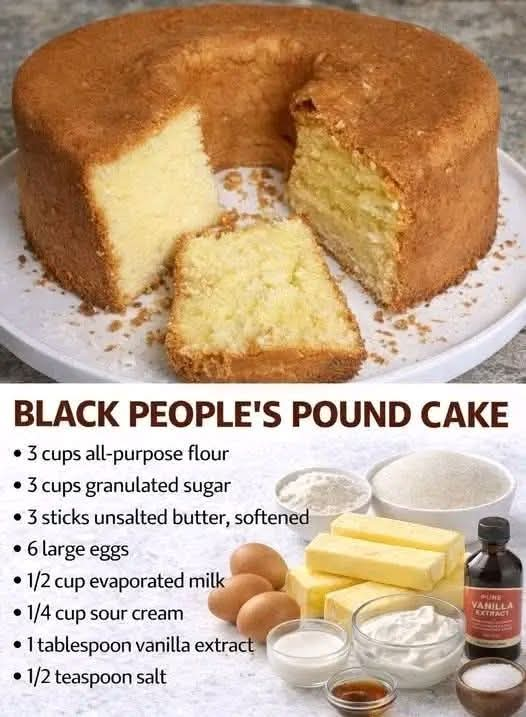
Black People Pound Cake: A Treasured Legacy
Don’t LOSE this Recipe
This isn’t just a cake; it’s a story baked into a golden crust, a piece of culinary heritage passed down through generations. Known affectionately within many families as “Black People Pound Cake,” this recipe represents resilience, tradition, and the soul-warming power of simple, perfect ingredients. Its name is a testament to its cherished place in Black American kitchens, where it became a staple for Sunday dinners, celebrations, and moments that called for something special. This cake is dense, moist, buttery, and profoundly satisfying—a true “pound” cake in the original sense, made to be shared with love.
—
The Grand Recipe
Ingredients:
· 3 cups (360g) all-purpose flour, sifted
· 3 cups (600g) granulated sugar
· 6 large eggs, room temperature
· 1 cup (2 sticks / 227g) unsalted butter, softened
· 1 cup (240ml) sour cream or whole milk (for extra moisture)
· 1 teaspoon vanilla extract (pure)
· 1 teaspoon almond extract (the “secret” for many)
· ½ teaspoon baking powder (optional, for a slight lift)
· ¼ teaspoon salt
Equipment:
· Tube pan (Bundt pan) or 2 large loaf pans, greased and floured
· Stand mixer or hand mixer
· Large mixing bowl
—
Instructions & Method
Method 1: The Classic Creaming Method (The Standard)
1. Preparation: Preheat your oven to 325°F (165°C). This lower temperature is crucial for even cooking without burning. Generously grease and flour your tube pan or loaf pans.
2. Cream Butter & Sugar: In your mixer bowl, beat the softened butter on medium speed until creamy and smooth. Gradually add the sugar, about 1 cup at a time, beating well after each addition. Continue beating for a full 5-7 minutes until the mixture is extremely pale, fluffy, and almost white. This step is NON-NEGOTIABLE for the right texture.
3. Incorporate Eggs: Add the eggs, one at a time, beating well (about 1 minute) after each egg. Scrape down the sides of the bowl as needed. The mixture should be smooth and emulsified.
4. Combine Dry Ingredients: In a separate bowl, whisk together the sifted flour, baking powder (if using), and salt.
5. Alternate Wet & Dry: Reduce mixer speed to low. Add the flour mixture and the sour cream/milk alternately to the butter mixture, beginning and ending with the flour (3 additions of flour, 2 of liquid). Mix just until combined after each addition. Do not overmix.
6. Add Flavor: Stir in the vanilla and almond extracts until just blended.
7. Bake: Pour the thick batter into the prepared pan(s) and smooth the top. Bake for 1 hour and 15 minutes to 1 hour and 30 minutes (less for loaf pans—start checking at 50 mins). The cake is done when a long wooden skewer inserted into the center comes out clean, the top is a deep golden brown, and the cake pulls away slightly from the pan’s edges.
8. Cool: Let the cake cool in the pan on a wire rack for 20 minutes. Then, carefully invert it onto the rack to cool completely (at least 2 hours) before slicing.
Method 2: The “All-in-One” Method (Grandma’s Quick Way)
Some family recipes simply call for combining all ingredients in a bowl and beating for 10-15 minutes straight. While less technical, this method relies on muscle (or mixer power) to incorporate air. Follow the same baking instructions.
—
A Brief History & Cultural Formation
The traditional pound cake dates back to 18th-century Europe, named for its formula: a pound each of flour, butter, eggs, and sugar. Enslaved Africans and their descendants adapted this recipe, often making do with what was available or given to them. Through skill and ingenuity, they perfected it, turning a simple European cake into a masterpiece of Black American cuisine. It became a symbol of grace and generosity, often baked for church events, fundraisers, and family reunions. Its formation in the community is tied to love, resourcefulness, and the act of “sweetening” life during bitter times.
—
Nutrition & Benefits
· Energy-Dense: Provides calories and energy, historically important for labor-intensive lives.
· Comfort Food: The sensory experience—butter, vanilla, sugar—offers psychological comfort and nostalgia.
· Portable & Shareable: Its sturdy texture made it perfect for travel and sharing, reinforcing community bonds.
· Note: This is a traditional, indulgent dessert. Enjoy it mindfully as part of a balanced diet. For a slightly modified version, you can reduce sugar to 2.5 cups or substitute half the butter for plain Greek yogurt, though this deviates from the classic.
—
For the Lovers of This Cake
This cake is for the memory-keepers, the Sunday dinner hosts, the ones who wrap slices in foil for guests to take home. It’s for the elders who measure in pinches and cups, not grams. It’s for celebrations and for quiet Tuesday nights with a glass of milk. To love this cake is to love tradition, to understand that food is history, and to know that sometimes, the most profound love is baked in a slow oven and dusted with nothing but confectioners’ sugar.
Conclusion
The Black People Pound Cake is more than dessert. It is edible resilience. It has graced tables from the Jim Crow South to Juneteenth celebrations and modern-day cookouts. It asks for no glaze, no frosting—its perfection is in its simplicity and profound flavor. By holding and baking this recipe, you are not just making a cake; you are keeping a legacy alive, one rich, buttery slice at a time.
So, bake it with care, share it with pride, and pass it on with the instruction: Don’t LOSE this Recipe.