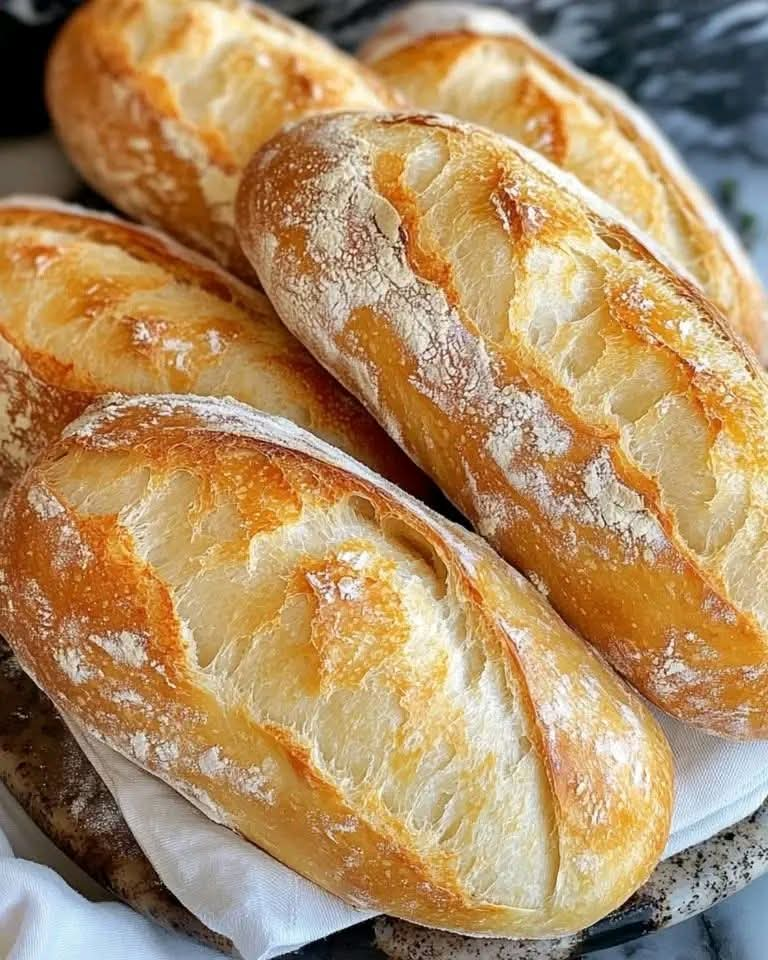
Of course. Here is a grand, comprehensive guide to your perfect Crusty Mini Baguettes, celebrating the beauty of real ingredients.
The Humble Masterpiece: A Treatise on Real Bread
In an age of convoluted labels and fleeting food trends, there exists a timeless truth: the greatest foods are often the simplest. This recipe for Crusty Mini Baguettes is a return to that fundamental principle—a celebration of flour, water, salt, and transformation. With no sugar, no eggs, no dairy, and no preservatives, it is bread in its most honest and triumphant form. It demands little but patience and rewards you with an experience: the audible crackle of the crust giving way to a soft, chewy, irregular crumb within. This is not just baking; it is an act of connection to a thousands-year-old craft.
—
The Historical Roots: Breaking Bread Through Time
The baguette, as a symbol, is distinctly French, but its essence is ancient. Its direct ancestor is the pain de campagne (country bread) of France, which itself evolved from the simple hearth loaves baked across Europe for millennia. The long, thin shape we recognize today became popular in Paris in the early 20th century, favored for its high crust-to-crumb ratio and portability. This recipe captures that spirit—not a Parisian baguette de tradition by strict regulation, but its soulful cousin, focused on the pure, rustic joy of a flour-and-water dough transformed by fire (or a home oven) into sustenance.
—
The Philosophy & Benefits: Why Pure Bread Nourishes More Than the Body
· Digestive Clarity: Free from added sugars and complex additives, this bread is gentle on the digestive system for many.
· Authentic Flavor: The taste is the true taste of wheat—nutty, slightly sweet, and deeply satisfying—enhanced only by the caramelization of the crust.
· Textural Therapy: The process of creating the crackly crust and airy interior is a lesson in food science and a sensory delight.
· Empowerment: Mastering these three ingredients proves you need nothing more to create something extraordinary. It is self-sufficiency in its most delicious form.
—
The Sacred Trio: Ingredients
· 2 1/4 cups (270g) All-Purpose or Bread Flour: Bread flour will yield a slightly chewier crumb due to its higher protein content, leading to more gluten development.
· 3/4 cup (180ml) Warm Water (around 110°F/43°C): The catalyst. Warmth awakens the yeast; precision is key.
· 1 teaspoon (6g) Salt: The flavor enhancer and regulator. It tightens gluten structure and controls yeast activity.
The Hidden Fourth Ingredient: Time.
—
The Method: A Ritual in Steps
Phase 1: Formation & First Rise (The Birth of Gluten)
1. In a large mixing bowl, combine the flour and salt. Whisk to incorporate.
2. Create a well in the center. Pour the warm water into the well.
3. Using a wooden spoon or your hands, mix until a shaggy, cohesive dough forms. It will be sticky.
4. Turn the dough out onto a lightly floured surface. Knead for 8-10 minutes. Use the heel of your hand to push the dough away, then fold it back over itself. It is ready when it becomes smooth, elastic, and barely tacky. This builds the gluten network—the skeleton of your bread.
5. Place the kneaded dough in a lightly oiled bowl, cover with a damp cloth or plastic wrap, and let it rise in a warm, draft-free place for 1.5 to 2 hours, or until doubled in size.
Phase 2: Shaping & Second Rise (Building Character)
1. Gently deflate the risen dough and turn it out onto a lightly floured surface. Divide it into 4 equal pieces.
2. Shaping the Mini Baguettes: For each piece:
· Gently pat into a rectangle.
· Fold the top third down to the center and press with your knuckles to seal.
· Fold the bottom third up to the center and seal.
· Now, starting from the center, gently roll and elongate the dough into a log about 6-7 inches long, tapering the ends slightly.
· The key is a tight, smooth surface to hold gas and create tension.
3. Place the shaped baguettes on a parchment-lined baking sheet, seam-side down. Cover loosely with the damp cloth and let rise for 45-60 minutes, until puffy.
Phase 3: Baking (The Alchemical Transformation)
1. Crucial Step: Preheat your oven to 450°F (230°C) at least 30 minutes before baking. Place an empty metal baking dish on the bottom rack.
2. Score the risen loaves with a sharp razor blade or lame at a 45-degree angle, making 3-4 shallow slashes along the length. This controls expansion.
3. Right before placing the baking sheet in the oven, carefully pour 1 cup of hot water into the preheated empty dish on the bottom rack. Close the oven door immediately. This creates a burst of steam, which is non-negotiable for achieving a crackly, glossy crust.
4. Bake the mini baguettes on the middle rack for 18-22 minutes, or until they are deeply golden brown and sound hollow when tapped on the bottom.
5. Transfer to a wire rack and let cool completely. Resist the urge to cut while warm, as the interior is still setting.
—
Nutritional Profile (Per Mini Baguette, Approximate)
· Calories: ~150
· Carbohydrates: 30g
· Protein: 4g
· Fat: <1g
· Fiber: 1g
· Sodium: 290mg
· Notable: A source of complex carbohydrates for sustained energy, small amounts of iron and B vitamins from enriched flour, and no cholesterol.
—
For the Lovers: Serving & Devotion
This bread is a canvas and a companion.
· The Purist: Tear into one, still slightly warm from the oven, and savor it alone, perhaps with a drizzle of excellent olive oil or a smear of cold, salted butter.
· The Host: Serve alongside a rich stew, a charcuterie board, or a simple soup. It is the ultimate utensil.
· The Gourmand: Split lengthwise for the ultimate panino or crostone, topping with ripe tomatoes, fresh mozzarella, and basil.
· The Romantic: Share a loaf, breaking it by hand—the oldest and most intimate form of communion.
—
Conclusion: The Eternal Return to Simplicity
These Crusty Mini Baguettes are more than a recipe; they are a testament. They prove that majesty lies in restraint, that flavor is born of patience, and that the most profound culinary pleasures are built on a foundation of just three real ingredients. In their crackle and crumb, you taste history, you feel science, and you hold in your hands the simple, undeniable truth of what bread should be. Bake them, share them, and celebrate the humble masterpiece you have created.