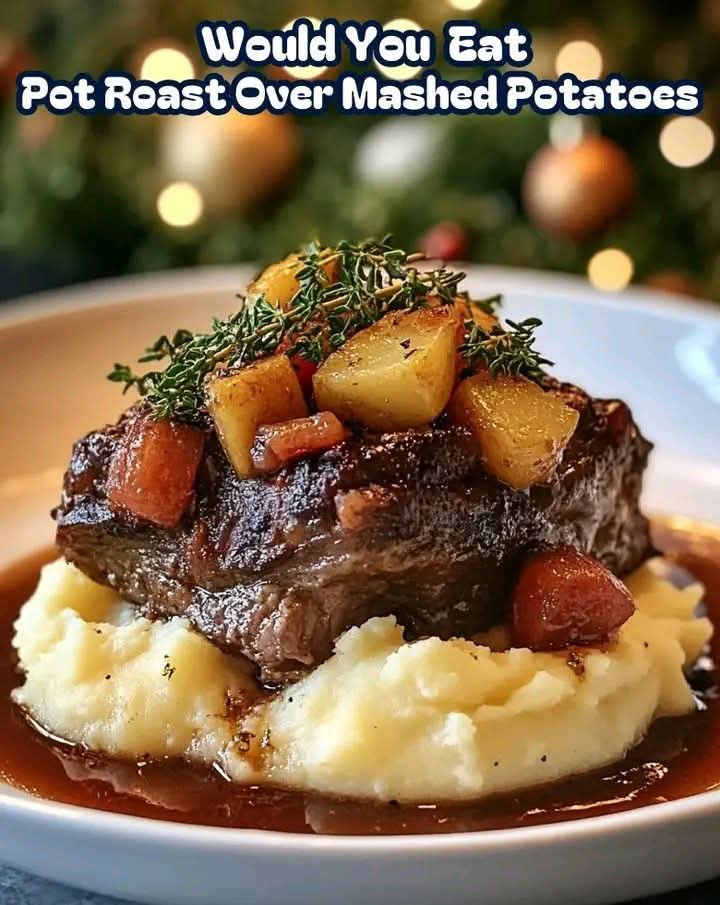
WOULD YOU EAT THIS POT ROAST OVER MASHED POTATOES? 🥔🍖
The Ultimate Comfort Food Classic
—
INTRODUCTION
There’s something magical about a fork-tender pot roast nestled atop a mountain of creamy, buttery mashed potatoes. This isn’t just a meal—it’s a warm hug on a plate, a Sunday dinner tradition, and the kind of food that makes you close your eyes with that first blissful bite. The answer to “Would you eat this?” is an enthusiastic, undeniable YES! This slow-cooked masterpiece transforms an economical cut of beef into something truly spectacular, while the mashed potatoes provide the perfect velvety bed to soak up all those rich, savory juices.
—
INGREDIENTS
For the Pot Roast:
· 3 lbs chuck roast – well-marbled for ultimate tenderness
· 2 tablespoons olive oil – for searing
· 1 large onion – sliced thickly
· 4 carrots – peeled and cut into 2-inch chunks
· 3 celery stalks – cut into 2-inch pieces
· 4 garlic cloves – minced
· 2 cups beef broth – preferably low-sodium
· 1 cup red wine (optional, or use more broth)
· 2 tablespoons tomato paste
· 2 sprigs fresh rosemary
· 3 sprigs fresh thyme
· 2 bay leaves
· Salt and freshly ground black pepper – to taste
· 1 tablespoon Worcestershire sauce
For the Creamy Mashed Potatoes:
· 3 lbs Yukon Gold potatoes – peeled and quartered
· 1/2 cup heavy cream – warmed
· 1/2 cup whole milk – warmed
· 6 tablespoons unsalted butter – softened
· Salt and white pepper – to taste
· 2 tablespoons fresh chives – chopped (for garnish)
—
INSTRUCTIONS
For the Perfect Pot Roast:
1. Preparation: Remove chuck roast from refrigerator 30-45 minutes before cooking. Pat completely dry with paper towels (this is crucial for a good sear). Season generously on all sides with salt and pepper.
2. The Sear: Heat olive oil in a large Dutch oven over medium-high heat until shimmering. Carefully place the roast in the hot oil and sear without moving for 4-5 minutes until a deep golden-brown crust forms. Flip and repeat on all sides, including the ends. Remove roast to a plate.
3. Build the Foundation: Reduce heat to medium. Add sliced onions to the pot and cook for 3-4 minutes, scraping up the browned bits (fond) from the bottom. Add carrots and celery, cooking for another 3 minutes. Add garlic and tomato paste, stirring constantly for 1 minute until fragrant.
4. Deglaze: Pour in red wine (if using) and Worcestershire sauce, scraping up any remaining browned bits. Let simmer for 2-3 minutes until reduced slightly.
5. The Slow Cook: Return roast to the pot along with any accumulated juices. Add beef broth until liquid comes about halfway up the roast. Add rosemary, thyme, and bay leaves. Bring to a simmer, then cover and transfer to a preheated 325°F (160°C) oven.
6. Patience: Cook for 3-4 hours, turning the roast once halfway through, until the meat is fork-tender and falling apart easily.
For the Creamy Mashed Potatoes:
1. Boil: Place potatoes in a large pot and cover with cold salted water by 1 inch. Bring to a boil, then reduce to a simmer and cook for 15-20 minutes until potatoes are fork-tender.
2. Drain and Dry: Drain well and return potatoes to the hot pot for 1-2 minutes to steam off excess moisture.
3. Rice or Mash: For the smoothest texture, pass potatoes through a ricer. Alternatively, mash thoroughly with a potato masher.
4. Enrich: Add softened butter and begin mashing while gradually pouring in the warmed cream and milk mixture. Continue until smooth and creamy. Season with salt and white pepper to taste.
The Grand Assembly:
Place a generous scoop of mashed potatoes in the center of each warmed plate. Using two forks, shred or chunk the pot roast and arrange it over the potatoes. Spoon plenty of the cooking liquid and vegetables over the top. Garnish with fresh chives and serve immediately.
—
HISTORY
Pot roast has humble beginnings, evolving from the European tradition of braising tough cuts of meat over long periods. German immigrants brought their “Sauerbraten” traditions to America, while the French contributed their “Boeuf à la Mode” techniques. In America, pot roast became synonymous with Sunday dinners and family gatherings during the Great Depression, when economical cuts of meat needed stretching and transforming. Mashed potatoes, originating in 17th century France and popularized in England, became the perfect companion—absorbing the rich gravy while adding their own comforting creaminess. Together, they form perhaps the most beloved comfort food duo in American culinary history.
—
BENEFITS
Nutritional Benefits:
· High-quality protein from chuck roast supports muscle health
· Iron and B-vitamins from beef for energy and blood health
· Beta-carotene from carrots supports eye health
· Fiber from vegetables aids digestion
· Potassium from potatoes helps regulate blood pressure
· Calcium from cream and butter supports bone health
Emotional Benefits:
· Stress reduction through comfort food association
· Family bonding during preparation and shared meals
· Mindfulness through the slow cooking process
· Satisfaction of creating something beautiful from simple ingredients
—
FORMATION (Cooking Science)
The magic of pot roast lies in collagen transformation. Chuck roast comes from the shoulder area, rich in connective tissue called collagen. When subjected to long, moist heat (between 180-205°F), collagen gradually breaks down into gelatin, which:
· Tenderizes the meat
· Creates that silky, luxurious mouthfeel
· Naturally thickens the cooking liquid into gravy
Meanwhile, the Maillard reaction during searing creates hundreds of flavor compounds, building the foundational savory depth that makes this dish so satisfying.
—
NUTRITION (Per Serving, Approximate)
Nutrient Amount
Calories 685 kcal
Protein 48 g
Fat 38 g
Carbohydrates 42 g
Fiber 5 g
Iron 6.5 mg
Potassium 1450 mg
Vitamin A 180% DV
Vitamin C 35% DV
Values are estimates and may vary based on specific ingredients and portion sizes.
—
LOVERS
This dish is beloved by:
· Busy families seeking a hearty, hands-off meal
· Home cooks wanting to impress without stress
· Meat lovers appreciating fall-apart tenderness
· Potato enthusiasts seeking the ultimate mashed potato experience
· Comfort food seekers on cold winter nights
· Sunday dinner traditionalists maintaining family rituals
· Meal preppers enjoying even better leftovers
—
METHODS
Three Ways to Cook Your Pot Roast:
1. Dutch Oven Method (as described above):
· Traditional, develops deepest flavor
· Creates perfect crust from oven heat
· Beautiful presentation for table service
2. Slow Cooker Method:
· Sear meat first (don’t skip this!)
· Transfer to slow cooker with vegetables and liquid
· Cook on LOW for 8-10 hours or HIGH for 5-6 hours
· Thicken liquid on stovetop before serving
3. Instant Pot/Pressure Cooker Method:
· Use sauté function to sear meat
· Add liquid and cook on HIGH pressure for 60-75 minutes
· Natural release for 15 minutes
· Quickest method without sacrificing tenderness
—
CONCLUSION
Would you eat this pot roast over mashed potatoes? Without hesitation, without reservation, and with complete and total enthusiasm! This dish represents everything wonderful about home cooking—patience rewarded, simple ingredients transformed, and love expressed through food. The fork-tender beef, the velvety potatoes, the rich vegetable-studded gravy—each element works in perfect harmony to create something far greater than the sum of its parts.
Whether you’re cooking for a special occasion, a Sunday family dinner, or simply treating yourself to the ultimate comfort food, this pot roast over mashed potatoes delivers every single time. It’s a reminder that the best things in life often come from the simplest beginnings, treated with care and cooked with love.
So fire up that oven, grab your heaviest pot, and prepare for a meal that will have everyone at the table asking for seconds—and the recipe. Because some dishes aren’t just food; they’re memories in the making.
Now, if you’ll excuse me, I have a date with a chuck roast and some Yukon Gold potatoes. And yes, I will absolutely be eating this. 🥔🍖
—
“Cooking is like love. It should be entered into with abandon or not at all.” — Harriet Van Horne