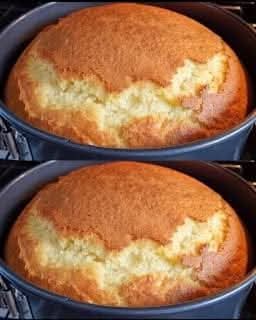
Here is a comprehensive, expanded recipe for a 3-Ingredient Sponge Cake, crafted to include all the elements you requested.
—
The Magic of Minimalism: The 3-Ingredient Sponge Cake
There is a special kind of magic in creating something extraordinary from almost nothing. In a world of complex pastry techniques and long lists of ingredients, this 3-Ingredient Sponge Cake stands as a testament to the beauty of simplicity. It’s a recipe that has been a secret weapon for home cooks for generations, proving that you don’t need a pantry full of exotic items to bake a cake that is light, airy, and undeniably delicious.
This isn’t just a recipe; it’s a foundation. With this single, simple technique, you can create the base for endless desserts—from a classic strawberry shortcake to a sophisticated tiramisu. It’s forgiving for beginners and a reliable staple for experts. So, whether you’re a seasoned baker or someone who’s never cracked an egg, I invite you to discover the pure joy of baking with just three humble ingredients. All it takes is a simple “hello” to unlock this culinary gem.
Hello and welcome to your new favorite recipe.
—
The Recipe
Introduction
This cake is often referred to as a “Genoise” in classic French baking, but this version strips it down to its absolute core. By relying on the scientific principle of air incorporation, we use whole eggs and sugar to create a stable foam, which is then gently bolstered by flour. There is no butter, no oil, no baking powder—just pure, eggy loft. The result is a cake that is slightly less rich than a traditional butter cake but has a unique, pleasant chew and a remarkable ability to absorb syrups without becoming soggy, making it the perfect canvas for other flavors.
Ingredients
· 4 large eggs (at room temperature)
· 120g (2/3 cup) granulated sugar
· 120g (1 cup) all-purpose flour (sifted)
Instructions (Methods)
Step 1: Preparation
Preheat your oven to 180°C (350°F). Grease and line the bottom of an 8-inch (20cm) round cake pan with parchment paper. Do not grease the sides of the pan; the batter needs the friction to climb as it rises.
Step 2: The Foaming Method (The Most Important Step)
In a large, heatproof bowl, combine the eggs and sugar. Place the bowl over a pot of simmering water (a bain-marie), ensuring the bottom of the bowl does not touch the water. Whisk constantly for about 3-5 minutes, until the sugar has dissolved and the mixture feels warm to the touch (about 40°C or 110°F). This step is crucial; it allows the eggs to whip to a much greater volume.
Step 3: Whipping to the Ribbon Stage
Remove the bowl from the heat. Using a hand mixer or a stand mixer fitted with the whisk attachment, beat the egg mixture on high speed. Beat for about 8-10 minutes, until it has tripled in volume, become thick and pale, and reached the “ribbon stage.” You’ll know it’s ready when you lift the whisk and the batter that falls back into the bowl leaves a trail (a ribbon) that sits on the surface for a few seconds before disappearing.
Step 4: The Delicate Incorporation
Sift the flour again over the egg foam in three separate additions. Using a large metal spoon or a rubber spatula, gently fold the flour in after each addition. The key here is to be light-handed. Use a swift cutting and folding motion, turning the bowl as you go, to incorporate the flour without knocking out the precious air you just whipped in.
Step 5: Baking
Gently pour the batter into the prepared pan and tilt it to spread it evenly. Bake for 25-30 minutes, or until the cake is golden brown and springs back when lightly touched. A toothpick inserted into the center should come out clean.
Step 6: Cooling
Remove the cake from the oven and let it cool in the pan for 10 minutes. Then, run a knife around the edge to loosen it (remember, you didn’t grease the sides, so it might stick a little) and turn it out onto a wire rack to cool completely upside down. This helps prevent it from collapsing.
—
The Story Behind the Cake
History
The sponge cake is an ancient creation, with roots tracing back to the Renaissance in Italy or Spain, but it was perfected in Europe during the 19th century. The “Genoise” cake, named after the city of Genoa in Italy, became the gold standard. However, the 3-ingredient version is a pared-down, utilitarian relative of that classic. It emerged from home kitchens where butter was a luxury or where cooks needed a simple, dependable recipe that could be dressed up for any occasion. It represents the ingenuity of home bakers who understood that the fundamental science of eggs and air could create something wonderful.
Benefits
· Simplicity: Only three ingredients, all of which are pantry staples.
· Versatility: It’s a blank canvas. Use it for layer cakes, trifles, ice cream cakes, or enjoy it plain with a dusting of powdered sugar.
· Dietary Considerations: It contains no butter or oil, making it lower in fat than many other cakes. It can easily be made dairy-free and, with a gluten-free flour blend, can be adapted for gluten-sensitive diets.
· Skill-Building: It teaches essential baking techniques: the bain-marie, the ribbon stage, and the art of folding.
Formation (The Science)
This cake is a foam cake. Its structure relies entirely on the egg-and-sugar foam.
1. Aeration: Whisking the eggs and sugar over heat denatures the proteins in the eggs and allows them to trap more air. The sugar dissolves, creating a thick, stable matrix.
2. Stabilization: As you whip, the egg proteins form a network around millions of tiny air bubbles. The sugar strengthens this network.
3. Structure: The flour provides the permanent structure. When you gently fold it in, the gluten (a protein in flour) forms a delicate web that will set in the oven.
4. Oven Spring: In the oven, the trapped air bubbles expand from the heat, and the steam from the eggs’ moisture helps the cake rise. The egg proteins then coagulate (solidify) and the flour’s starch sets, creating the final, solid crumb.
Nutrition (per serving, 1/8 of cake)
· Calories: ~150
· Fat: 3g
· Carbohydrates: 27g
· Protein: 5g
For the Lovers of Cake
This cake is for the purists who appreciate the flavor of a simple egg and a hint of sweetness. It’s for the minimalist who finds joy in uncomplicated processes. It’s for the busy parent who needs a quick and impressive dessert. And most of all, it’s for anyone who believes that the most profound pleasures in life are often the simplest.
Conclusion
This 3-Ingredient Sponge Cake is more than just a recipe; it’s a philosophy. It teaches us that we don’t need complexity to achieve excellence. With a little patience, a gentle hand, and a bit of kitchen magic, three humble ingredients can transform into a towering, beautiful cake. So, the next time you’re craving something sweet but want to avoid a lengthy shopping list, remember this recipe. It’s a simple “hello” to a world of delicious possibilities.
Happy baking