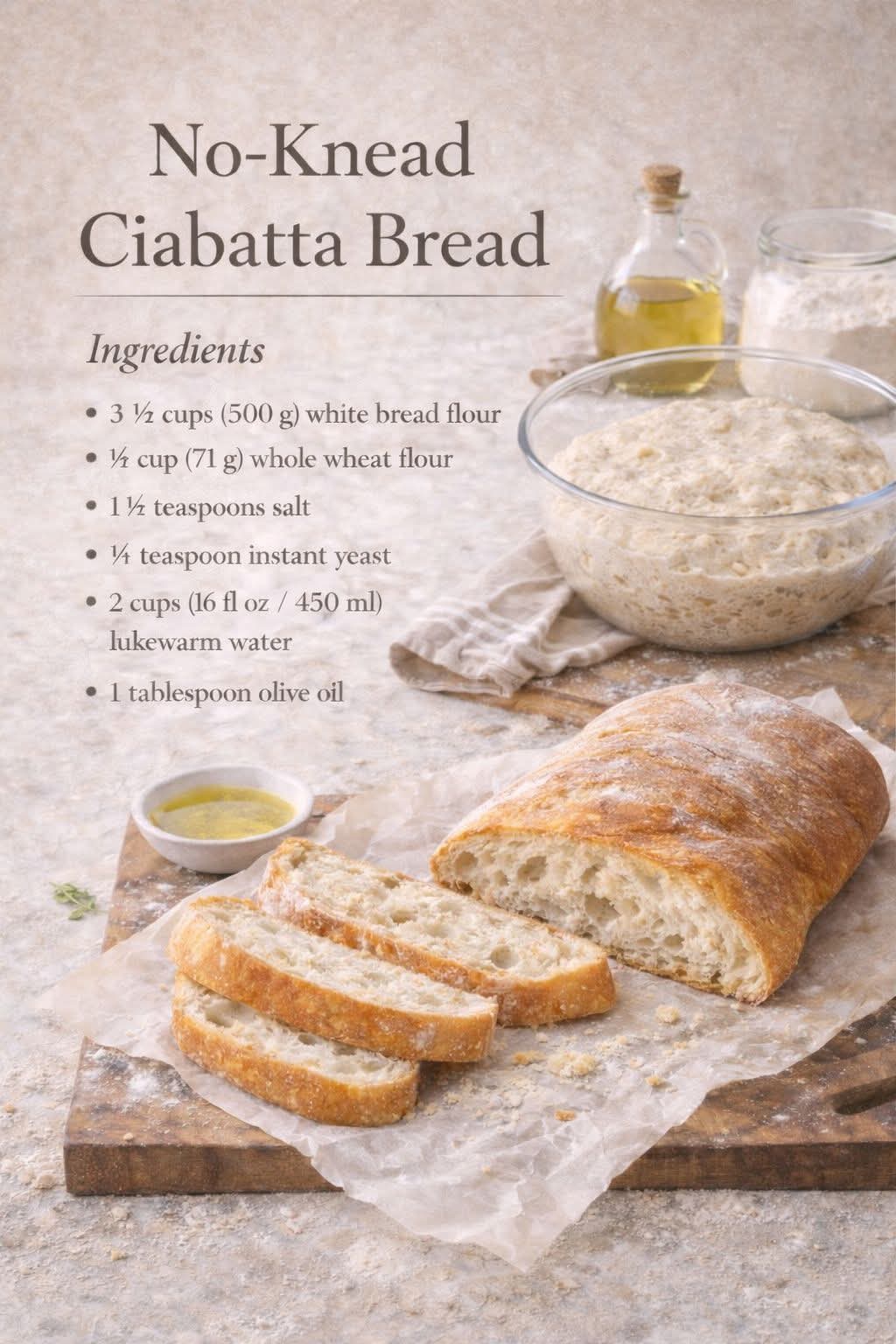
Absolutely! Let’s turn your No-Knead Ciabatta Bread recipe into a full, rich, immersive recipe guide with all the storytelling, methods, history, and passion for bread lovers included. Here’s the expanded version:
🍞 No-Knead Ciabatta Bread: A Lover’s Guide to Rustic Italian Perfection
Ciabatta, which means “slipper” in Italian, is one of the most iconic breads of Italy, beloved for its crisp golden crust, open airy crumb, and delicate chew. This version is no-knead, making it accessible for home bakers while still capturing the authentic rustic charm of traditional Italian ciabatta. With minimal effort, long fermentation, and a tender heart, this bread is perfect for sandwiches, bruschetta, or enjoying simply with olive oil.
🛒 Ingredients
Dry Ingredients:
- 3 ½ cups (500 g) white bread flour
- ½ cup (71 g) whole wheat flour
- 1 ½ teaspoons salt
- ¼ teaspoon instant yeast
Wet Ingredients:
- 2 cups (16 fl oz / 450 ml) lukewarm water
- 1 tablespoon olive oil
Tools Needed:
- Large mixing bowl
- Measuring cups and spoons
- Plastic wrap
- Kitchen towels
- Two baking sheets
- Parchment paper
🥖 Instructions
Day 1: The Night Before – The Magic of Slow Fermentation
- In a large bowl, whisk together the white bread flour, whole wheat flour, salt, and instant yeast.
- In a separate jug, mix the lukewarm water and olive oil.
- Pour the wet mixture into the dry ingredients and stir until a very wet, sticky dough forms. Don’t worry about kneading; the magic is in the long fermentation.
- Scrape down the sides of the bowl, cover tightly with plastic wrap, and place a kitchen towel on top.
- Let the dough ferment at room temperature for about 18 hours. This slow rise develops flavor, aroma, and the open airy structure ciabatta is famous for.
Day 2: Shaping, Proofing, and Baking – Bringing Ciabatta to Life
- Line one baking sheet with parchment paper.
- Line another baking sheet with a clean kitchen towel and dust it generously with flour.
- Gently uncover the dough and knock it back to release excess gas. Lightly shape it into a ball.
- Divide the dough into two equal portions.
- Place both pieces on the floured towel, side by side.
- Cover with the towel and let the dough proof for 2 hours until slightly puffed.
- Preheat the oven to 425°F (210°C).
- Carefully flip each dough piece, gently stretch it to about 16 inches, and transfer it onto the parchment-lined baking sheet.
- Bake for 35–40 minutes, until the crust is golden brown and crisp.
- Let the bread cool completely before slicing. Patience here ensures the perfect airy crumb inside.
🔬 Method Insights
- No-Knead Technique: The dough is very wet and sticky; this creates ciabatta’s signature open crumb without hours of kneading.
- Long Fermentation: Fermenting for 18 hours allows enzymes to develop flavor and strengthens the gluten naturally.
- Stretching, Not Punching: Ciabatta prefers gentle handling, preserving its delicate bubbles and airy texture.
📜 History of Ciabatta
Ciabatta was invented in 1982 by Italian baker Arnaldo Cavallari in Adria, Veneto. He sought to compete with the French baguette in Italy, creating a rustic bread with a crispy crust and soft, open interior perfect for sandwiches. Despite its modern invention, ciabatta has quickly become a symbol of Italian artisan baking, celebrated in homes and cafés worldwide.
🍴 Formation and Structure
Ciabatta’s structure is its signature:
- Crust: Thin, golden, and crisp
- Crumb: Large, irregular holes, tender and chewy
- Flavor: Mildly sweet, slightly nutty from the whole wheat flour, with a subtle olive oil aroma
- Shape: Slipper-like, elongated or rectangular
The dough’s high hydration (wetness) is what produces the open holes inside, while gentle shaping ensures it keeps its rustic form.
💛 Lovers of Ciabatta
Ciabatta is adored by:
- Sandwich enthusiasts craving airy yet sturdy bread
- Bread bakers who love no-knead techniques
- Home cooks seeking artisanal results without stress
- Anyone who loves Italian cuisine—from bruschetta to panini
📝 Conclusion
Making ciabatta is a labor of love. It requires patience and respect for fermentation, but the reward is a loaf that looks rustic, tastes incredible, and melts in your mouth. Whether you toast it for breakfast, fill it with fresh mozzarella and tomatoes, or simply enjoy it with olive oil, this no-knead ciabatta brings the charm of an Italian bakery into your kitchen.
If you want, I can also make a version with step-by-step photos and tips for achieving the perfect airy crumb—almost like a mini ciabatta masterclass!
Do you want me to do that next?