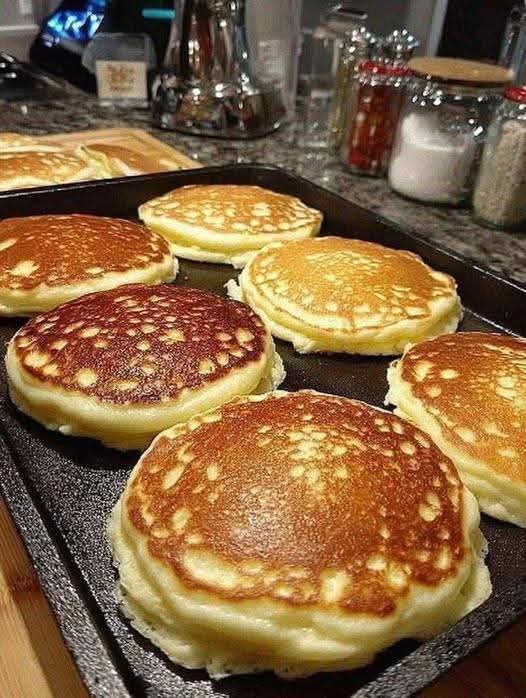
Here is a big, beautiful, and comprehensive guide to making the “Better-Than-Original” Fluffy American Pancakes, crafted just for you. Get ready to fall in love all over again!
—
The Quest for the Perfect Fluff: A Pancake Love Story
Introduction
There are pancakes, and then there are pancakes. You know the ones I’m talking about. The kind that hang heavy in your memory, the ones from a perfect diner or a cherished childhood kitchen. They are golden brown, impossibly tall, with a texture so light and airy they practically dissolve on your tongue. For too long, many of us have settled for the flat, dense, or box-mix versions, convincing ourselves that carbs were the enemy. But then, you take a bite of a truly perfect pancake, and your entire world view shifts. You realize it wasn’t the carbs you were missing; it was this.
This recipe is the culmination of years of pancake research, a dedicated quest to achieve that mythical 1000-times-better status. It’s a love letter to the weekend morning, to the simple joy of a stack of cakes dripping with maple syrup and melting butter. This isn’t just a recipe; it’s an experience. Welcome to your new obsession.
—
The Master Recipe: 1000-Times-Better Fluffy American Pancakes
This recipe is designed for consistency and maximum fluff. The secret lies in the technique: treating the ingredients with respect and not overmixing.
Yields: 8-10 medium-sized pancakes
Prep time: 10 minutes
Cook time: 15 minutes
Ingredients
· Dry Ingredients:
· 1 ½ cups (190g) All-purpose flour (spooned and leveled)
· 3 ½ teaspoons Baking powder
· 1 teaspoon Salt
· 1 tablespoon White granulated sugar (This helps with browning, not just sweetness)
· Wet Ingredients:
· 1 ¼ cups (300ml) Milk (Whole milk is best for richness, but 2% works well)
· 1 large Egg
· 3 tablespoons Unsalted butter, melted (plus more for the pan and serving)
· 1 teaspoon Vanilla extract
Instructions & Methods: The Path to Perfection
Step 1: The Preparation (Mise en Place)
Before you begin, have all your ingredients measured and ready. Place a large non-stick griddle or skillet over medium-low heat. It’s crucial that the pan heats up slowly and evenly. If it’s too hot, your pancakes will burn on the outside before the inside is cooked. Melt a small pat of butter on the griddle; it should sizzle gently, not brown immediately.
Step 2: The Great Combine (Don’t Overmix!)
In a large bowl, whisk together the dry ingredients: flour, baking powder, salt, and sugar. This ensures the baking powder is evenly distributed.
In a separate medium bowl or a large liquid measuring cup, whisk together the wet ingredients: milk, egg, melted butter, and vanilla extract until well combined.
Make a well in the center of the dry ingredients. Pour the wet ingredients into the well. Using a spatula or a fork, gently fold the ingredients together. Stop mixing as soon as the flour is incorporated. The batter will be thick, lumpy, and far from smooth. This is exactly what you want. Overmixing develops the gluten in the flour, which will result in tough, rubbery pancakes instead of light, fluffy ones. Let the batter rest for 5 minutes while the pan finishes heating. This allows the baking powder to activate and the gluten to relax.
Step 3: The Art of the Flip
Check your pan’s temperature. Sprinkle a few drops of water on it; if they dance and evaporate, it’s ready. Lightly butter the pan.
For each pancake, ladle about ¼ cup of batter onto the hot griddle. Do not crowd them; leave space for expansion.
Cook until bubbles form on the surface and begin to pop, and the edges look set and slightly dry (about 2-3 minutes). The bottom should be a beautiful, deep golden brown.
Using a thin, wide spatula, confidently flip the pancake in one swift motion. Cook for another 1-2 minutes on the second side, until golden brown and cooked through.
Transfer to a plate and keep warm in a low oven (200°F or 95°C) while you cook the remaining batter. Repeat with the remaining batter, adding a little more butter to the pan between batches as needed.
The History of the Pancake
The pancake is one of the oldest and most ubiquitous forms of bread in human history. Nearly every culture has its own version. The ancient Greeks and Romans ate pancakes made with wheat flour, olive oil, honey, and curdled milk. In Medieval Europe, cooks would test their griddles by pouring a small amount of batter on them – the origin of the “trial cake” or “crumpet.”
The thick, fluffy American pancake we know and love is a descendant of these early griddle cakes. Its rise to prominence is tied to the availability of chemical leaveners like baking soda and, later, baking powder in the mid-19th century. Before that, pancakes were leavened with yeast or stiffly beaten egg whites, making them thinner and more like a crêpe or a pikelet. The invention of baking powder in the 1850s was a game-changer, allowing home cooks to create light, airy, and reliably fluffy pancakes without the wait. The American pancake, often served in a stack for breakfast, became a symbol of hearty, home-cooked comfort.
The Benefits (Beyond Just Happiness)
While we eat them for joy, these pancakes offer some surprising benefits:
· Mood Booster: Carbohydrates help the body produce serotonin, a “feel-good” neurotransmitter. Hence, the love!
· Energy Source: Provides a quick source of energy from the carbs and sustained energy from the protein and fat in the milk and egg, making it a great start to a busy day.
· Customizable Nutrition: This recipe is a perfect canvas. You can easily boost its nutritional profile by adding a scoop of protein powder, substituting ½ cup of flour with whole wheat or oat flour, or folding in antioxidant-rich blueberries.
· A Moment of Mindfulness: The process of making pancakes—the whisking, the waiting for bubbles, the satisfying flip—can be a simple, grounding ritual in a busy world.
The Formation of the Fluff: A Scientific Breakdown
Ever wonder how these little discs of joy achieve their signature lift? It’s kitchen chemistry in action!
1. The Leavening Agent: Our primary leavener is baking powder. It’s a double-acting agent, meaning it creates gas bubbles in two stages. First, when it hits the liquid (the wet ingredients), it starts a chemical reaction that produces carbon dioxide. Second, and most importantly, it releases more gas when it gets hot (on the griddle).
2. The Gas Trap: The gluten network in the flour (which we’ve carefully preserved by not overmixing) forms stretchy walls that trap these expanding carbon dioxide bubbles.
3. The Heat Sets the Structure: As the pancake cooks on the hot griddle, the heat causes the proteins in the egg and flour to set and solidify, locking the air bubbles in place. The result? That glorious, towering, cloud-like structure.
Nutritional Information (Per Serving – 2 pancakes)
Please note this is an estimate and can vary based on specific ingredients used.
· Calories: Approximately 350-400 kcal
· Protein: 9-11g
· Fat: 14-17g (mostly from butter and milk)
· Carbohydrates: 45-50g
· Sugar: 8-10g (includes natural and added)
· Fiber: 1-2g
A Final Word for the Lovers (Conclusion)
This is more than a stack of pancakes; it’s a declaration of love. A love for simple, honest food that brings people together. A love for the alchemy of turning flour, milk, and eggs into something transcendent. A love for the quiet joy of a perfect bite.
So, to all the pancake lovers out there—the ones who have strayed and found their way back, the ones who never left, and the ones about to experience pancake nirvana for the first time—this recipe is for you. May your griddle be hot, your butter be melting, and your stack be ever in your favor.
Welcome home, carb lover.