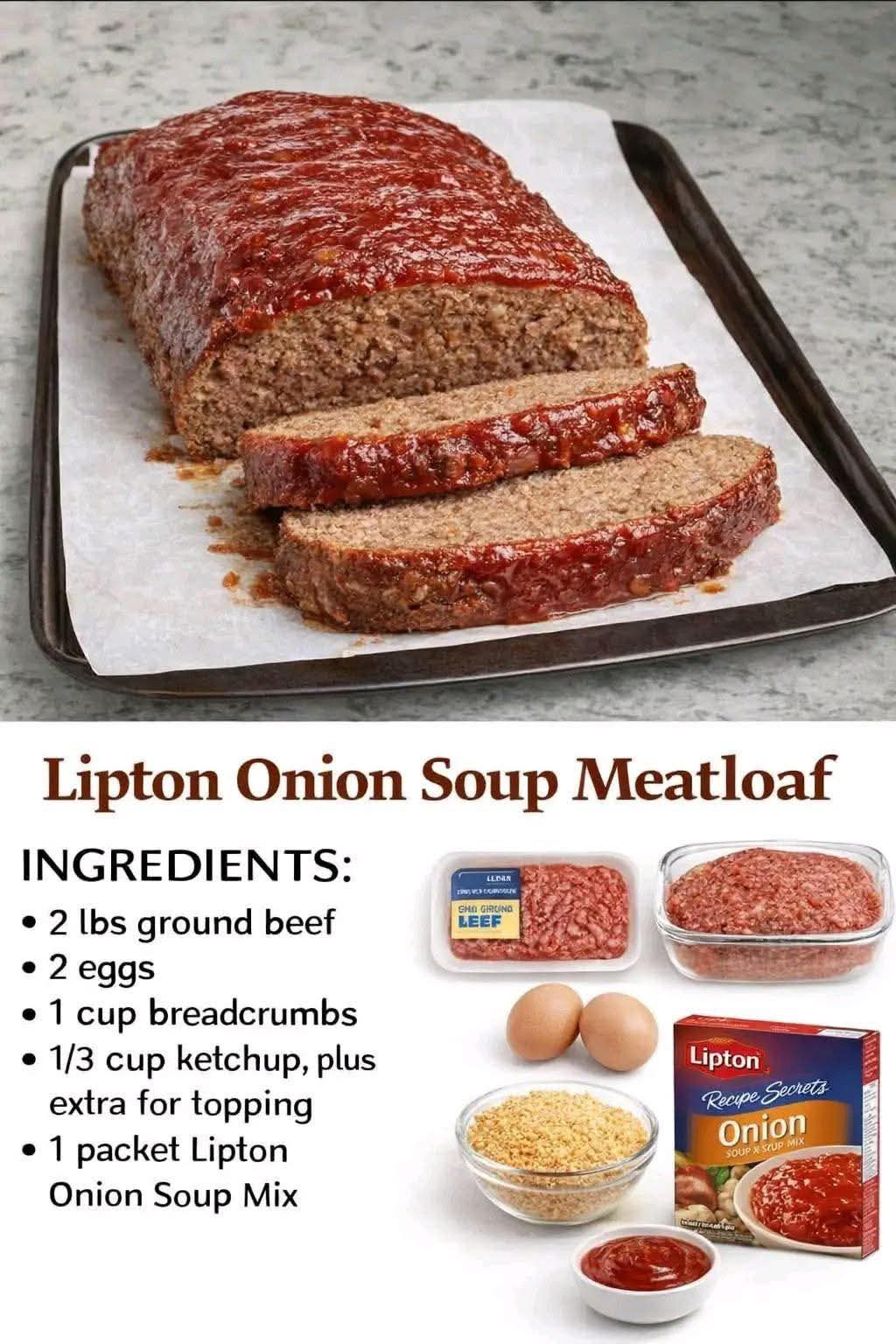
Here is a big, comprehensive guide to Lipton Onion Soup Meatloaf, crafted to include all the elements you requested.
The Ultimate Guide to Lipton Onion Soup Meatloaf: A Souperior Comfort Food Classic
Introduction
In the pantheon of American comfort food, few dishes evoke the warmth of home and the nostalgia of family dinners quite like meatloaf. It is the quintessential weeknight meal—hearty, satisfying, and deeply personal, with countless variations passed down through generations. Yet, amidst the myriad of recipes that call for fresh herbs, sauteed aromatics, and intricate spice blends, one version stands out for its brilliant simplicity and unwavering reliability: Lipton Onion Soup Meatloaf.
This recipe is more than just a meal; it is a testament to the genius of mid-century American cooking, where convenience and flavor converged to create something truly special. By incorporating a simple packet of dehydrated onion soup mix, this meatloaf achieves a depth of savory, umami-rich flavor that mimics the complexity of slowly caramelized onions, all without the extra prep work . It’s the “no-fail” recipe that has rescued countless home cooks and become a beloved staple for a reason. This guide will explore everything there is to know about this iconic dish, from its historical roots to a detailed, foolproof recipe that will ensure a juicy, flavorful, and perfect meatloaf every single time. Get ready to discover why this simple combination of ingredients creates a “souperior” dining experience .
—
The History: A Postwar Phenomenon
To truly appreciate Lipton Onion Soup Meatloaf, one must understand the era that gave it life. The story begins not with meatloaf, but with a dip. Lipton introduced its onion soup mix in 1952, a product of the postwar convenience food boom . In an era where more women were entering the workforce but remained the primary homemakers, there was a surging demand for products that could cut down on time spent in the kitchen without sacrificing the expectation of a home-cooked meal .
The product’s fate changed forever in 1954 when an unknown home cook created “California Dip” by mixing a packet of the soup mix with sour cream . The recipe became a sensation, and Lipton, recognizing a golden opportunity, launched a massive advertising campaign to promote not just the dip, but a whole range of dishes that could be enhanced by their product . It was through this campaign, appearing in magazines like Good Housekeeping, that the Lipton Onion Soup Meatloaf recipe was introduced to the American public . It was the perfect solution for families seeking the nostalgic, hearty taste of home-cooked food without spending hours in the kitchen—a desire that remains just as relevant today as it was in the 1950s .
—
The Star Ingredient: What’s in the Packet?
The magic of this dish lies in the little envelope of Lipton Recipe Secrets Onion Soup Mix. It’s a carefully calibrated blend of ingredients designed to deliver a powerful punch of flavor. While the exact recipe is a secret, the packet typically contains dehydrated onions, salt, corn starch, onion powder, sugar, soy sauce powder, caramel color, and sunflower oil . The combination of these elements, particularly the soy sauce and caramelized onion flavor, creates a deep, savory umami sensation that penetrates the meat as it bakes, providing a complexity that would normally require slow-cooking fresh onions for an hour or more .
—
The Big Recipe: Lipton Onion Soup Meatloaf
This recipe synthesizes the classic “Souperior” method with tips and tricks from expert sources to guarantee a moist, flavorful, and structurally perfect loaf .
Preparation Details
· Prep Time: 15 minutes
· Cook Time: 1 hour to 1 hour 15 minutes
· Rest Time: 10 minutes (crucial!)
· Total Time: Approximately 1 hour 25 minutes to 1 hour 40 minutes
· Servings: 6-8
· Equipment Needed: Large mixing bowl, small bowl, loaf pan (or baking sheet), foil or parchment paper, instant-read meat thermometer.
Ingredients
This ingredient list is built for a 2-pound meatloaf, the standard for a family meal with fantastic leftovers .
For the Meatloaf:
· 2 pounds ground beef (80/20 blend): The 20% fat content is the secret to a moist, tender loaf. Leaner blends (like 90/10 or 93/7) will often result in a dry meatloaf, as the fat renders out and keeps the meat juicy .
· 1 envelope Lipton Recipe Secrets Onion Soup Mix: This is your entire spice cabinet in one packet. Do not substitute with a can of prepared onion soup .
· 2 large eggs, lightly beaten: The eggs act as a binder, helping to hold the loaf together when sliced .
· ¾ cup plain dry breadcrumbs: Breadcrumbs are the other essential binder. They absorb moisture and prevent the meat from becoming dense. For variations, you can use 1 ½ cups of fresh breadcrumbs, crushed crackers, or even quick-cooking oats .
· ¾ cup water or milk: This liquid hydrates the breadcrumbs and soup mix, ensuring the meatloaf is moist throughout. Using milk can add a touch of richness .
· 1 tablespoon Worcestershire sauce (optional): Adds another layer of savory depth and acidity .
For the Signature Glaze:
· ⅓ cup ketchup
· 1-2 tablespoons brown sugar (optional): This adds a sweet, caramelized counterpoint to the savory meat. It’s a classic addition that many swear by .
Instructions: A Step-by-Step Method to Success
Following these steps carefully will ensure your meatloaf turns out perfectly every time.
Step 1: Prepare and Preheat
Preheat your oven to 350°F (175°C) . If using a loaf pan, lightly grease it or line it with parchment paper for easy removal. For a crispier exterior, line a rimmed baking sheet with foil and place a wire rack on top.
Step 2: Create the Flavor Base (The “Panade” Method)
In your large mixing bowl, combine the breadcrumbs, water (or milk), beaten eggs, Worcestershire sauce (if using), and the entire envelope of Lipton onion soup mix . Whisk this mixture together and let it sit for 2-5 minutes. This crucial step allows the breadcrumbs to fully absorb the liquid, creating a paste known as a “panade.” This guarantees an even distribution of moisture and flavor and prevents the meatloaf from becoming dry or crumbly .
Step 3: Gently Combine with the Meat
Add the ground beef to the bowl with the panade. Now, using your hands (the best tool for the job), gently mix everything together. The key word here is gentle. Combine the ingredients just until they are incorporated and no streaks of raw flour remain. Overmixing at this stage compacts the meat, resulting in a tough, dense loaf .
Step 4: Shape the Loaf
Turn the meat mixture out onto your prepared pan or baking sheet. Gently shape it into a loaf approximately 8-9 inches long, 4-5 inches wide, and about 2 inches high. If using a loaf pan, gently press the mixture into the pan, being careful not to pack it down too tightly .
Step 5: Apply the Glaze
In a small bowl, stir together the ketchup and brown sugar (if using). Spread this mixture evenly over the top and sides of the shaped loaf. This glaze will bake into a tangy, sweet, and slightly sticky crust that is the hallmark of a great meatloaf .
Step 6: Bake to Perfection
Place the meatloaf in the preheated oven. Bake uncovered for approximately 1 hour to 1 hour and 15 minutes. The exact time will depend on the shape and thickness of your loaf. The most reliable way to know it’s done is to use an instant-read meat thermometer. Insert it into the center of the loaf; it should register 160°F (71°C) .
Step 7: The Mandatory Rest
This is perhaps the most important and most overlooked step. Once out of the oven, let the meatloaf rest on a cutting board or cooling rack for at least 10 minutes, tented loosely with foil. During this time, the juices that have been driven to the center by the heat will redistribute throughout the loaf. If you skip this step and slice immediately, those juices will run out onto the cutting board, leaving you with a dry meatloaf .
Step 8: Slice and Serve
After resting, use a serrated knife to slice the meatloaf cleanly. Serve with classic comfort food sides like creamy mashed potatoes and steamed green beans .
—
The Benefits: Why This Recipe is a Keeper
· Unbeatably Easy: With just a handful of ingredients and minimal prep, it’s the perfect recipe for busy weeknights .
· Foolproof and Reliable: The soup mix guarantees a consistent flavor profile every time, eliminating the guesswork of seasoning from scratch .
· Budget-Friendly: Ground beef and pantry staples make this an economical choice for feeding a crowd .
· Deep, Savory Flavor: The soup mix provides a complex, umami-rich taste that belies its simple origins .
· Customizable Canvas: The basic recipe is a perfect starting point for your own additions and variations (see below).
—
The Lovers: Perfect Pairings and Leftovers
Meatloaf is a dish that brings people together, and its leftovers are just as beloved as the first meal.
· Classic Pairings: For a balanced, comforting plate, serve your meatloaf with creamy mashed potatoes or buttered egg noodles and a simple green vegetable like steamed broccoli, green beans, or peas . A side of creamy mashed cauliflower is a great low-carb alternative.
· The Legendary Meatloaf Sandwich: This is where the magic truly lives on. Take a cold or gently reheated slice of meatloaf and place it between two slices of toasted bread (white, sourdough, or ciabatta are excellent choices). Spread with a little mayo, add some crispy lettuce, and maybe a slice of tomato. For a gourmet twist, try it on toasted garlic ciabatta with crispy fried onions and pickles .
—
Nutritional Information
Please note that these values are estimates and will vary based on the specific ingredients and portion sizes used. The figures below are based on a recipe serving 6-8 people with 80/20 ground beef .
Nutrient Approximate Value (per serving)
Calories 280 – 350 kcal
Total Fat 15g – 20g
Saturated Fat 6g – 8g
Cholesterol 85 – 125mg
Sodium 590 – 720mg
Total Carbohydrates 12g – 16g
Dietary Fiber 1g
Total Sugars 3g – 6g
Protein 18g – 35g
—
Conclusion
Lipton Onion Soup Meatloaf is far more than a simple recipe; it is a cherished piece of American culinary history that continues to grace dinner tables decades after its inception. It masterfully bridges the gap between the desire for a wholesome, home-cooked meal and the practical need for convenience. Its “no-fail” nature makes it the perfect dish for novice cooks building their confidence, while its deeply satisfying flavor and nostalgic appeal keep it in heavy rotation for even the most experienced home chefs.
By following the detailed methods outlined in this guide—embracing the panade, mixing with a gentle hand, and honoring the crucial rest time—you are not just making dinner; you are participating in a tradition. You are creating a meal that is juicy, flavorful, and reliable. So the next time you’re seeking comfort, look no further than that little envelope of soup mix. It holds the secret to a dish that is, in every way, “souperior.” Enjoy, and happy cooking